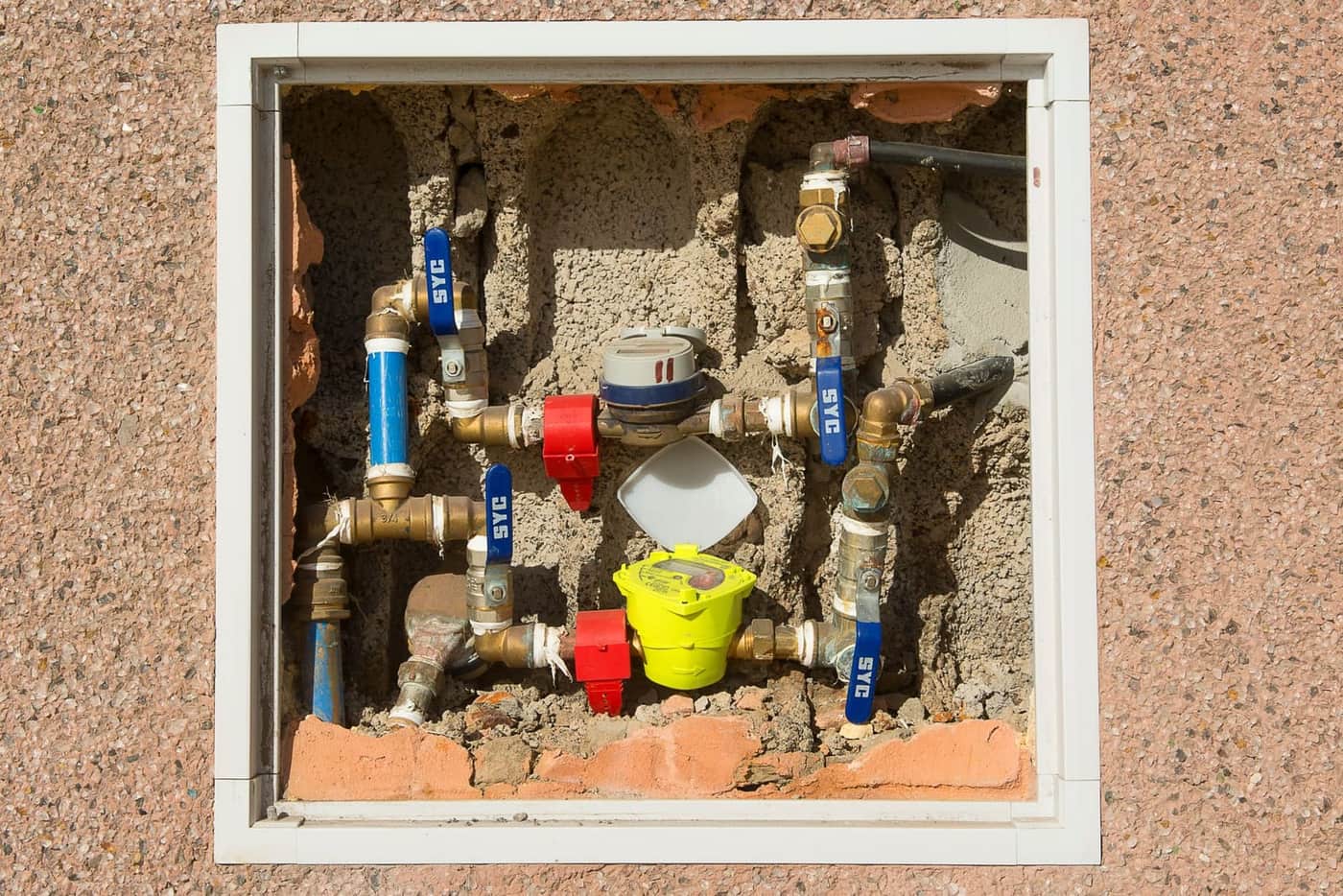
Start at the meter. Shut off every fixture and appliance, note the meter reading or the position of the low-flow indicator, wait fifteen minutes and read it again. Any movement with nothing running means water is escaping somewhere between the meter and your fixtures. From there you narrow it down: toilets first, then irrigation, then hot versus cold, then the slab.
Step 1: The Meter Test (Confirm You Actually Have a Leak)
Before chasing a stain on a ceiling or a warm patch on a floor, establish whether water is genuinely leaving the system. The meter does this definitively and it costs nothing. Most residential meters have a small triangular, star-shaped or wheel-shaped low-flow indicator that spins on even the smallest continuous flow, which is more sensitive than the digits.
Do this on a calm day when nobody is coming or going, because the test only works if nothing in the house is using water. Ice makers and irrigation controllers are the two things people forget.
- Turn off every tap, shower, dishwasher, washing machine and ice maker. Switch the irrigation controller to off, not just to a paused program. Ask everyone in the house not to flush for the duration.
- Find the meter, usually in a ground box near the street or the curb. Lift the lid carefully - these boxes are a favorite spot for insects and snakes in Texas - and wipe the glass.
- Look at the low-flow indicator. If it is turning at all with nothing running, you have a continuous leak and you can stop the test right there.
- If it is not moving, write down the full meter reading including the small digits, then leave everything off for fifteen to thirty minutes.
- Read it again. Any change means water moved. No change over thirty minutes means no continuous leak, though it does not rule out an intermittent one such as a toilet flapper that only passes water part of the time.
- If you found movement, repeat the test with the main shut-off valve at the house closed. If the meter stops, the leak is inside or under the house. If it keeps moving, the leak is in the service line between the meter and the house.
Step 2: Rule Out the Easy Suspects
The great majority of confirmed household leaks are not hidden at all. Before anyone cuts into anything, eliminate the fixtures and systems that leak quietly and constantly.
Toilets are the single biggest offender. A worn flapper lets water pass from tank to bowl continuously with no sound and no visible overflow, and a single bad flapper can account for a startling jump in a water bill. The dye test takes ten minutes and settles it.
Irrigation is the second. A cracked lateral or a stuck valve in a sprinkler system puts water straight into the ground where nothing shows, and in a North Texas summer the lawn looks like it is just responding to watering.
- Dye test every toilet. Drop food coloring or a dye tablet into the tank, do not flush, and come back in fifteen to twenty minutes. Color in the bowl means the flapper is passing water. Our guide on a toilet that keeps running covers the fix.
- Check under every sink with a flashlight and a dry paper towel on the supply connections and the trap. Look for mineral crust and dark swollen cabinet bases as well as active drips.
- Look behind and under the dishwasher, washing machine and refrigerator with the ice maker line. Flexible supply hoses are a common failure point.
- Walk the irrigation zones with the system off and look for a persistently soggy or unusually green patch, a sunken area, or water weeping from a valve box.
- Check the water heater pan and the floor around it, and look at the temperature-and-pressure discharge tube. Our water heater leaking guide covers that sequence.
- Check every outdoor hose bibb and the vacuum breaker on top of it. These leak more often than people expect, and ours is a freeze-thaw climate that splits them.
- Look at the pressure relief points and any water softener or filtration drain line, which can run continuously if the unit is stuck in a regeneration cycle.
Step 3: Narrow It Down to Hot, Cold or the Slab
If the meter says there is a leak and the obvious suspects are clear, the next job is to cut the search area down. Three simple tests do most of that work, and they are the information a plumber most wants when they arrive.
Start with the hot-versus-cold split. Close the cold-water inlet valve on top of the water heater and repeat the meter test. If the meter stops, the leak is on the hot side, which immediately halves the pipe you have to think about and is a strong hint toward an under-slab hot line - the hot run is the one that fails first in most slab homes because heat accelerates corrosion.
Next, listen. With the house quiet and nothing running, put an ear to the floor in different rooms, or use a screwdriver handle against your ear with the tip on the slab. A pressurized leak under concrete often makes a faint continuous hiss or rushing sound. It is crude, but it localizes a leak to a room surprisingly often.
Then feel the floor. A hot-line slab leak warms the concrete above it, and on tile you can often find a patch noticeably warmer than the surrounding floor with the back of your hand or a bare foot. Combined with the hot-side meter test, that is close to a diagnosis.
- Hot-side isolation: close the water heater cold inlet and repeat the meter test. Meter stops means the leak is on the hot side.
- Listening: a faint continuous hiss or rush with the house silent, strongest directly over the leak.
- Warm spots: a hot-line slab leak heats the floor above it. Check with the back of your hand across tile and hard flooring.
- Visible symptoms at the edges: baseboards swelling, flooring cupping or lifting, a hairline crack in a slab weeping moisture, or a persistently damp strip at the exterior foundation line.
- Smell: a musty or earthy odor in one room, or mold appearing in a corner with no obvious water source above it.
- Pressure: take a static pressure reading at an outdoor spigot. High pressure both causes leaks and makes existing ones worse, and a reading over 80 psi points at a failed regulator. Our water pressure regulator guide covers that test.
- Water bill history: compare the last few bills. A step change that has stayed high points to a continuous leak; a single spike points to something that has since stopped.
Why Dallas-Area Homes Hide Leaks Well
The same search would be easier in a different part of the country, and it is worth knowing why it is harder here.
Almost every home in the Dallas area sits on a concrete slab. There is no basement and usually no crawl space, so the supply lines either run under the slab or overhead through the attic. A leak in an under-slab line has no visible path to you - the water goes into the soil beneath your foundation, and the first symptoms are indirect: a higher bill, a warm floor, a sound.
The soil then compounds it. North Texas expansive clay absorbs that water and swells, which is why a slab leak is a structural concern and not just a plumbing one. It also means the leak may not surface anywhere at all, even after weeks.
Pipe age is the third factor. The region's huge 1960s to 1980s build-out used copper supply lines, which develop pinholes as they age, and pockets of polybutylene from the late 1970s through the mid-1990s, which fails at fittings. Both are now at the age where failures cluster. Our guides on polybutylene pipe replacement and the signs of a slab leak go into both.
Finally there is pressure and water chemistry: mineral-rich water scales pipe interiors and high static pressure stresses every joint, including the joints you cannot inspect.
When to Stop and Call a Licensed Plumber
Everything above is safe for a homeowner and genuinely useful. There is a clear point where the tools change and the work becomes a licensed trade, and in Texas plumbing work must be performed by a licensed plumber.
- The meter confirms a leak but all your checks come back clean. The remaining candidates are inside walls, under the slab or in the service line, and finding those needs equipment.
- You suspect a slab leak. Acoustic listening devices, tracer gas, thermal imaging and pressure testing are the professional tools, and guessing where to cut concrete is an expensive guess.
- The meter keeps moving with the house main closed, which puts the leak in the service line between meter and house.
- Water is appearing through a ceiling, or you can see a stain spreading. Shut the water off at the main first; our shut-off guide covers where the valve is.
- You smell gas at any point, which is a separate emergency: leave, do not touch switches, and call the gas utility from outside.
- Mold is already visible, which means the leak has been running long enough to need remediation as well as repair.
- The water bill has jumped significantly. The cost of professional detection is usually less than a couple of months of a leak you cannot find.
What Leak Detection Costs (Published Figures With Sources)
Dallas Best Plumber is a free referral service. We do not set prices and nothing here is our quote. Below are the figures independent publishers report for finding a leak and for the repairs that commonly follow, named and dated.
Detection is normally billed separately from the repair, and it is the part you commit to before knowing the total. Ask whether it is credited against the repair if you proceed, because practice varies.
| Service | Published figure |
|---|---|
| Slab leak detection (locating a leak under the slab)Fixr.com, Slab Leak Repair Cost, updated May 1, 2025. This Old House, updated April 7, 2026, gives $150 to $600 | $100 - $400 |
| Leaking pipes - repairThis Old House, Plumbing Cost Guide, updated June 6, 2026 | $150 - $450 |
| Broken pipe repairFixr.com, updated May 1, 2025, and This Old House, updated April 7, 2026 - both give the same range | $200 - $2,000 |
| Water line repairThis Old House, updated April 7, 2026 | $300 - $1,400 |
| Slab leak repair - overallFixr.com, updated May 1, 2025, national average $2,500. This Old House, updated April 7, 2026, gives $630 to $4,400 with a $2,300 average; its Plumbing Cost Guide, June 6, 2026, lists a slab leak at $500 to $4,000 | $1,000 - $4,000 |
| Main water line leakThis Old House, Plumbing Cost Guide, updated June 6, 2026 | $500 - $4,000 |
| Burst pipeThis Old House, Plumbing Cost Guide, updated June 6, 2026 | $1,000 - $4,000 |
| Plumber labor - hourlyFixr.com, updated May 1, 2025; typical $75 to $130 per hour, with inspection taking 1 to 3 hours and a minimum labor charge of $150 to $200 plus the inspection on small jobs | $45 - $200 / hour |
These are published figures from Fixr.com (updated May 1, 2025) and This Old House (updated April 7, 2026 and June 6, 2026; cost data from HomeAdvisor unless otherwise noted). They are national, not Dallas-Fort Worth specific, not Dallas Best Plumber's prices and not a quote. Detection and repair are usually billed separately. We are a free referral service: we do not set prices and we do not perform work.
Sources: Fixr.com - Slab Leak Repair Cost (updated May 1, 2025); This Old House - Slab Leak Repair Cost (updated April 7, 2026); This Old House - Plumbing Cost Guide (updated June 6, 2026)
Get Matched With a Licensed Dallas-Area Plumber
Dallas Best Plumber is a free referral service, not a plumbing company. If the meter test says you have a leak and you have narrowed it as far as you can, tell us what you found - whether the meter stopped with the main closed, whether it stopped with the water heater isolated, where the warm spot is - and we match you with a licensed, insured plumber serving your ZIP. They call you with a free, no-obligation quote.
Those three facts are worth real money to you. A plumber who arrives knowing the leak is on the hot side, inside the house, and probably in a specific room spends their time confirming rather than searching.
If water is actively running and you cannot find the source, shut the main off first and request the match second. Our guide on shutting off the water to your house covers exactly where to look for the valve in a slab-built Texas home.
Still stuck? Get matched with a licensed local pro
We'll connect you with a licensed, insured plumber in the Dallas-Fort Worth area for a free, no-obligation quote.
Related guides
- Signs of a Slab Leak (and How to Confirm One)A slab leak rarely announces itself. It shows up as a warm patch, a water bill that will not come back down, or the sound of water with the house silent.
- Slab Leak Repair CostThe method decides the price, and the method is decided under your floor. Here is what independent publishers report for each one, and why the spread is so wide.
- How To Shut Off The Water To Your HouseThis is the one piece of plumbing knowledge that decides how bad a burst pipe gets. It takes ten minutes to learn and you only need it once.
- Water Pressure Regulator ReplacementA failed regulator is a quiet, expensive problem: it stresses every joint, valve and appliance in the house at once. Here is how to test for it.
- Toilet Keeps Running? Here Is Why, and the FixA running toilet is the most expensive small leak in a house - and usually a part that costs less than a takeaway meal.
Frequently asked questions
How do I find a water leak in my house?
Start with the meter test: turn off everything that uses water, including ice makers and irrigation, then watch the meter's low-flow indicator or compare readings fifteen to thirty minutes apart. Movement means a leak. Then dye-test the toilets, check appliance hoses and irrigation, and isolate the water heater's cold inlet to see whether the leak is on the hot side.
How much does leak detection cost?
Fixr.com publishes slab leak detection at $100 to $400 and This Old House gives $150 to $600. Detection is usually billed separately from the repair, and some plumbers credit it against the work if you proceed - worth asking before booking. Those are published national figures, not our prices and not a quote.
Can a water leak go undetected for months?
Easily, in a slab-built home. Water from an under-slab supply line goes into the soil beneath the foundation with no visible path indoors, so the only early signals are an unexplained water bill, a warm patch on the floor from a hot-line leak, or a faint sound with the house quiet. That is why the meter test is the right place to start.
What is the most common cause of a hidden water leak?
A running toilet, by a wide margin - a worn flapper passes water continuously with no sound or visible overflow. After that come appliance supply hoses, irrigation lines, outdoor hose bibbs, and in older slab homes pinholes in aging copper supply lines. Dye-test the toilets before assuming anything hidden.
Does a water leak raise my water bill much?
It can, significantly, and the bill pattern is diagnostic. A step change that stays high month after month points to a continuous leak somewhere in the system. A single spike that returned to normal points to something that has stopped, like an irrigation cycle or a toilet that has since reseated. Compare several bills rather than one.
Should I shut off my water if I cannot find the leak?
If water is actively running or you can see damage spreading, yes - shut off the main at the house and leave it off until a plumber arrives. If the leak is slow and contained, you can leave the water on while you finish the checks, but shut it off whenever you leave the house for any length of time.