Dallas & the DFW metroplex
Water Filtration & Softeners in Dallas & DFW
Scale on the fixtures, a taste you do not like, a water heater that keeps failing early - get matched with a licensed local pro who installs filtration properly.
Get a free quote
Matched with a licensed local pro — fast.
Water filtration in Dallas is usually a response to one of two complaints, and they need different equipment. The first is hard water - white crust on aerators and glass, soap that will not lather, water heaters failing before their warranty is up, fixture cartridges scaling shut. That is a softener problem. The second is taste, smell or a worry about what is in the water - a chlorine or chloramine note, a question about lead from old interior pipe, a preference for filtered drinking water. That is a filtration problem. Plenty of homes want both, and a lot of money gets wasted buying one when the complaint called for the other.
Dallas Best Plumber is a free referral service, not a plumbing company and not a water treatment dealer. We have nothing to sell you, which is a useful position from which to explain the options. Tell us what you are actually experiencing and we match you with a licensed, insured local plumber who installs filtration and softening equipment in Dallas and the surrounding suburbs and calls you back with a free, no-obligation quote.
This page covers what is genuinely in DFW tap water according to the cities' own published reports, which problem each type of equipment solves, what a proper installation involves, and what filtration will not fix.
What is actually in DFW tap water
Start with the published facts rather than a sales pitch. Nearly every city in this metroplex buys treated surface water from one of two suppliers and distributes it.
On the Dallas side, Dallas Water Utilities treats surface water from seven sources - the Elm Fork of the Trinity River and lakes Ray Roberts, Lewisville, Grapevine, Ray Hubbard, Tawakoni and Fork - at one of three treatment plants, and sells it to customer cities. The Town of Addison's 2024 water quality report states it purchases its water entirely from the City of Dallas; the City of Farmers Branch's report states it purchases water through an agreement with Dallas while owning and operating its own distribution system. Both describe the same seven sources.
On the Collin County side, the North Texas Municipal Water District supplies member and customer cities. The Town of Prosper's annual water quality report states that all of its water is treated water purchased from NTMWD, and that the district relies on surface water from Lavon Lake, Lake Texoma and Jim Chapman Lake (Cooper Lake). NTMWD describes its treated water as moderately hard, primarily because of minerals from Lavon Lake, and notes those minerals leave scale on fixtures while posing no risk to health.
Two practical conclusions follow. First, the water arriving at your meter is treated, regulated and tested, and the annual report for your own city is a free public document worth reading before you buy anything. Second, treated surface water in North Texas is hard, and hardness is a nuisance and an appliance cost rather than a health problem. If a salesperson tells you your city water is unsafe, check that against your city's own report.
- Hardness - calcium and magnesium; harmless to drink, hard on heaters and fixtures
- Chloramines - used for secondary disinfection in much of the region; a common taste and smell complaint
- Disinfection byproducts - regulated and reported annually in every city's water quality report
- Lead and copper - come from service lines and interior household plumbing, not the treated supply
Softener, whole-house filter, or point-of-use?
The three categories solve three different problems, and matching the equipment to the complaint is the whole job.
A water softener addresses hardness. It swaps the calcium and magnesium for sodium or potassium, which protects the water heater, keeps scale off glass and fixtures, improves how soap behaves, and extends the life of appliances that use hot water. It does not improve taste, does not remove chlorine or chloramine, and does not filter sediment. It needs salt or potassium added periodically and a drain connection for its regeneration cycle.
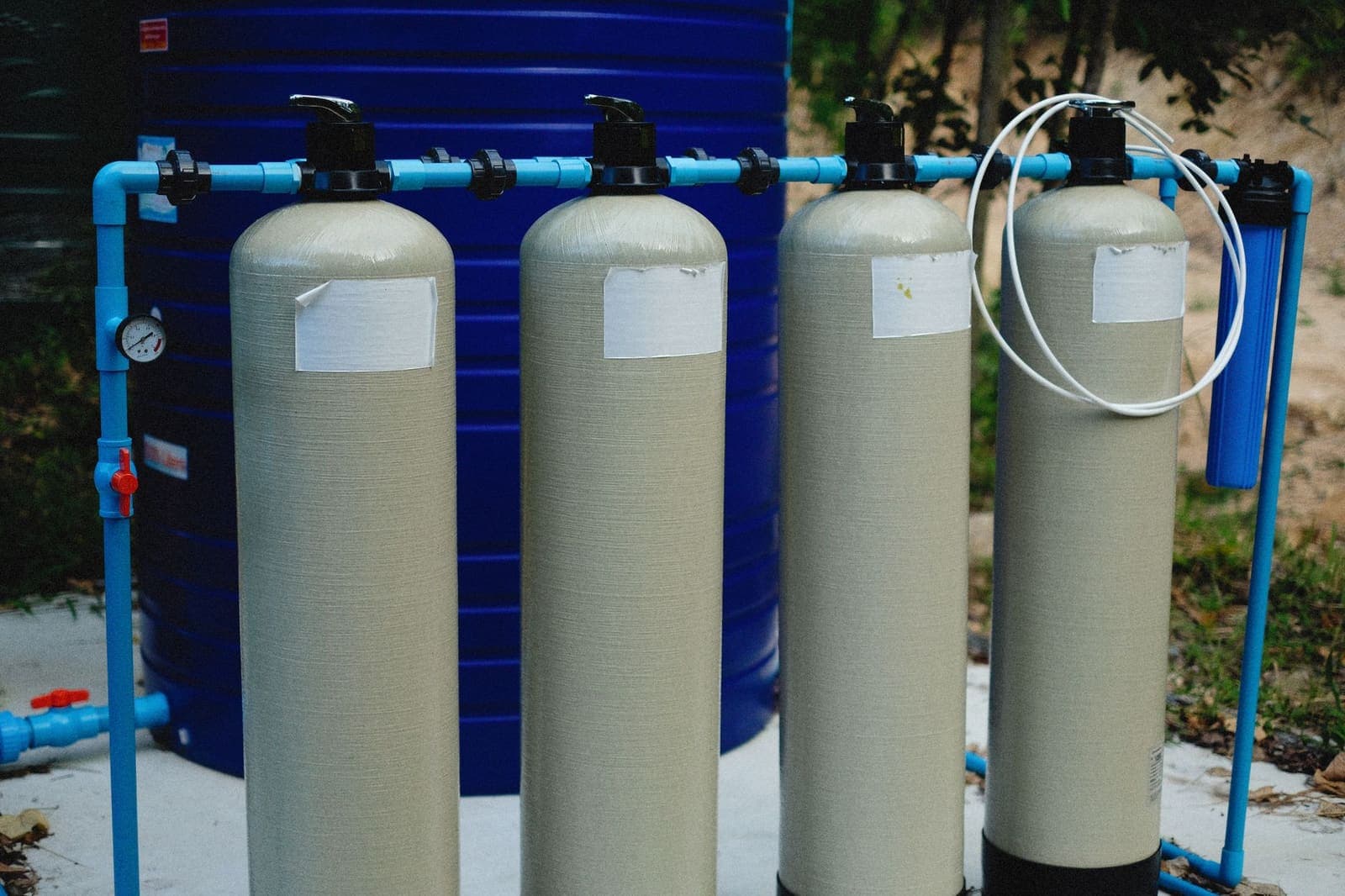
A whole-house filter addresses what the water carries rather than how hard it is. Depending on the media, it can reduce chlorine and chloramine taste and smell, catch sediment, or target specific contaminants. It treats every tap in the house, including showers, which is why people who dislike the smell of the water usually want this rather than a drinking-water filter. Media and cartridges need replacing on a schedule, and skipping that schedule makes things worse rather than neutral.
Point-of-use filtration treats one tap. An under-sink carbon filter or a reverse-osmosis system at the kitchen sink gives you filtered drinking and cooking water without treating the water used for laundry and showers, and reverse osmosis in particular removes a far broader range of dissolved substances than a whole-house carbon filter does. It is the cheapest way to change your drinking water and the least useful way to protect your plumbing - which is why a lot of DFW homes end up with a softener for the house and an RO unit at the kitchen sink.
- Scale, poor lather, heaters failing early - a softener is the answer
- Chlorine or chloramine taste and smell throughout the house - whole-house filtration
- Just want better drinking and cooking water - point-of-use carbon or reverse osmosis
- Sediment or grit after a main break or repair - a sediment filter, possibly temporary
Why hard water costs DFW homeowners real money
Hardness is easy to dismiss as cosmetic because it is not a health issue, and then it quietly becomes the most predictable plumbing expense in the metroplex. Here is the mechanism. In a tank water heater, the dissolved minerals drop out of solution when the water is heated and settle on the bottom of the tank, over the burner in a gas unit or around the element in an electric one. That layer insulates the heat source from the water, so the unit runs longer to reach the same temperature. You hear it as popping and rumbling, feel it as a shorter hot shower, and pay for it on the gas or electric bill - and then the unit fails earlier than it should have.
In the tankless units now common in newer DFW homes, the same minerals narrow the heat exchanger. A tankless heater that is never descaled starts throwing error codes or short-cycling, and most manufacturers make periodic descaling a condition of the warranty. In the rest of the house, scale crusts faucet aerators and shower cartridges - stiff handles, weak flow - and builds on the fill valve, flapper seat and rim jets inside a toilet tank, which causes running toilets and early part failure.
A softener does not make any of that free, but it does change the slope. The decision is a straightforward one: the cost of the equipment and its ongoing salt against the cost of heaters, cartridges and valves failing early across the whole house. For a family that has already replaced one water heater sooner than expected, the arithmetic usually resolves itself.
What a proper installation involves
This is where a licensed plumber earns the difference over a box-store install, and the details are worth knowing before you compare quotes.
A whole-house softener or filter has to go on the incoming main, after the meter and ahead of the fixtures it is meant to protect - and usually after a dedicated outdoor hose bib, because there is no reason to soften the lawn. Many DFW homes built in the last few decades have a plumbed softener loop in the garage or utility area ready for this; older homes often do not, and the line has to be opened and re-piped. A bypass is essential so the unit can be taken out of service without shutting the house down.
A softener also needs a drain for its regeneration cycle, and that connection has to be made with the correct air gap so there is no path for drain water to be drawn back into the softener. It needs a power supply for the control valve. If the house has a tankless or a high-efficiency heater, the order of equipment on the line matters. And if the system is being installed because a water heater just failed, doing both at once avoids paying twice for the same pipe work.
Reverse-osmosis units at a kitchen sink have their own requirements: a dedicated faucet, a drain saddle, a storage tank under the cabinet, and - if you want filtered water at the fridge - a line run to the ice maker. None of that is complicated, and all of it is done badly often enough to be worth paying a licensed plumber to do.
- Installed on the incoming main, after the meter, typically after an outdoor hose bib
- Bypass fitted so the house still has water when the unit is serviced
- Regeneration drain connected with a proper air gap
- Existing softener loop used where the home has one; re-piped where it does not
- Order of equipment considered where there is a tankless or high-efficiency heater
What filtration will not fix
Being honest about the limits saves money. A softener will not improve the taste of your water - if the chloramine note is what bothers you, softening it changes nothing. A whole-house carbon filter will not stop scale; it is not a softener and does not remove hardness minerals. Neither one will raise your water pressure: if pressure is poor throughout the house, the cause is more likely a failing pressure-reducing valve, a partially closed valve, or - in pre-1960 housing - galvanized supply pipe that has rusted shut from the inside, and adding equipment to that line will make it slightly worse rather than better.
Filtration also does not fix lead in household plumbing at its source. The cities' own water reports are explicit that lead in drinking water comes primarily from materials and components associated with service lines and home plumbing rather than from the treated supply. Point-of-use filtration certified for lead reduction will treat the water at that tap, but if you want to know what your service line and interior piping are actually made of, that is a question for a licensed plumber looking at your house.
And no filtration system fixes a plumbing failure. If a drain is backing up, a line is leaking, or a heater is at the end of its life, treat that first. Equipment installed onto a system that is about to be opened up again is money spent in the wrong order.
What drives the cost of water treatment
We are a free referral service and we do not set prices - your matched plumber gives you the quote, and equipment pricing in this category varies enormously between brands and between a dealer and a plumber. What is worth understanding is the shape of the cost.
The equipment itself is the largest single line, and it ranges from a single-cartridge point-of-use filter to a dual-tank whole-house system. The installation cost after that depends almost entirely on what your house already has: a home with a plumbed softener loop, a nearby drain and power is a straightforward install, while a home where the main has to be opened, a drain run, and a circuit provided is a substantially bigger job. Where the equipment sits - garage, utility room, outside wall, attic - changes the labor. And there is an ongoing cost that quotes sometimes understate: salt or potassium for a softener, cartridges or media for a filter, membranes for reverse osmosis, and periodic descaling if you have a tankless heater.
Two pieces of advice that cost nothing. Read your own city's annual water quality report before you buy, so you know what you are treating for. And get the hardness and the complaint diagnosed before you choose equipment - buying a softener for a taste problem, or a carbon filter for a scale problem, is the most common and most avoidable mistake in this category.
Where we match water filtration pros
We connect homeowners with licensed local plumbers across the Dallas-Fort Worth metroplex, including:
- Dallas, TX
- Plano, TX
- Irving, TX
- Garland, TX
- Richardson, TX
- Carrollton, TX
- Mesquite, TX
- McKinney, TX
- Frisco, TX
- Rockwall, TX
- Allen, TX
- Lewisville, TX
- Rowlett, TX
- Grand Prairie, TX
- Flower Mound, TX
- Forney, TX
- Wylie, TX
- Little Elm, TX
- The Colony, TX
- Duncanville, TX
- Coppell, TX
- Cedar Hill, TX
- DeSoto, TX
- Prosper, TX
- Addison, TX
- Farmers Branch, TX
Helpful guides
Related services
- Water Heater Repair & ReplacementNo hot water or a leaking tank? Get matched with a licensed local pro who can tell you honestly whether to repair or replace - free, no-obligation quote.
- Toilet & Faucet RepairRunning toilet or dripping faucet? Get matched with a licensed local pro for fast toilet and faucet repairs and fixture installs - free, no-obligation quote.
- Leak DetectionA bill that keeps climbing, a meter that never stops, a damp spot with no source - get matched with a licensed local pro who finds the leak before anything gets opened up.
Frequently asked questions
Is Dallas water hard?
Yes. Treated surface water in North Texas is hard. The North Texas Municipal Water District, which supplies much of Collin County, describes its treated water as moderately hard, primarily because of minerals from Lavon Lake, and notes those minerals leave scale on fixtures while posing no health risk. Dallas Water Utilities treats surface water from the Elm Fork of the Trinity River and six lakes for Dallas and its customer cities, and hardness there shows up the same way - scale on fixtures and in water heaters.
Do I need a water softener or a water filter?
It depends on the complaint. Scale on fixtures and glass, soap that will not lather and water heaters failing early are hardness, and a softener is the answer. A chlorine or chloramine taste and smell is not hardness, and a softener will not touch it - that is whole-house filtration, or point-of-use filtration if you only care about drinking and cooking water. Many DFW homes install a softener for the house and a reverse-osmosis unit at the kitchen sink.
Will a water softener improve the taste of my water?
Generally no, and this is the most common misunderstanding in this category. A softener removes hardness minerals; it does not remove chlorine or chloramine, which is what most taste and smell complaints are actually about. If taste is your complaint, a carbon filter - whole-house or at the tap - is the equipment that addresses it.
Is DFW tap water safe to drink?
Your city publishes the answer every year and you should read it rather than take ours. The Town of Prosper's report states its supply surpassed the strict regulations of both the State of Texas and the U.S. EPA; Addison's and Farmers Branch's reports describe water treated by the City of Dallas under TCEQ regulation. Hardness, which is the most noticeable characteristic of water here, is an appliance and fixture issue rather than a health one. If anyone selling equipment tells you your city water is unsafe, check that claim against your city's own report.
Can filtration remove lead from my pipes?
Point-of-use filtration certified for lead reduction treats the water at that one tap, which is useful. But the cities' own reports are explicit that lead in drinking water comes primarily from service lines and home plumbing rather than the treated supply, so filtration treats the symptom at one fixture. If you have an older home and want to know what your service line and interior piping are made of, ask the licensed plumber you are matched with to identify the materials while they are on site.
Should a plumber install it, or can I buy one from a dealer?
Either can work, but the installation is where the quality difference shows. A whole-house unit has to go on the incoming main after the meter with a bypass fitted, a regeneration drain connected with a proper air gap, and power to the control valve - and in a home without an existing softener loop the main has to be opened and re-piped. A licensed plumber does that as routine plumbing work, and the equipment is only as good as the pipework it sits in.
Need water filtration in Dallas or DFW?
Tell us what's happening and we'll match you with a licensed, insured local plumber. Free quote, no pressure.
Get a Free Quote