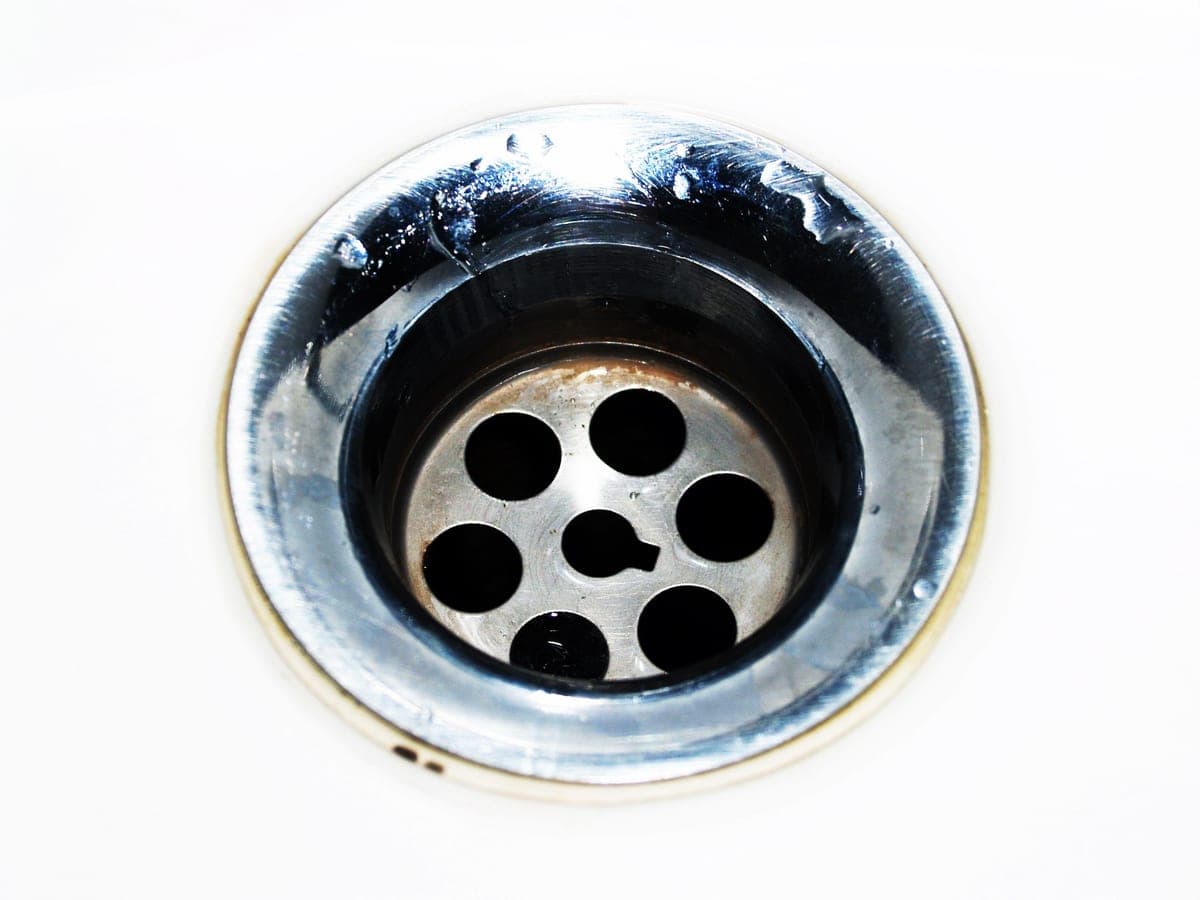
Clear the standing water, then try a plunger over the drain with the other basin and the dishwasher line sealed off. If that fails, bail the trap area dry and remove the P-trap under the sink - grease and food debris collect there. Avoid chemical drain cleaner. If both basins back up or other fixtures gurgle, the blockage is past the sink and needs a plumber.
Why Kitchen Sinks Clog More Than Any Other Drain
A kitchen sink takes the hardest service in the house. Everything that goes down it is either greasy, starchy, fibrous or abrasive, and unlike a shower drain it has no hair to blame. Cooking fat goes down warm and liquid, travels a few feet into cooler pipe, and congeals on the wall of the line. Coffee grounds, rice, pasta and flour settle into that film instead of passing through it. Over months the pipe narrows from the inside until a normal day's dishes will not drain.
The geometry works against you too. A kitchen drain leaves the basket strainer, drops into a P-trap, and then usually runs horizontally for some distance before it reaches a vertical stack. That horizontal run is where debris stops moving. On a double-bowl sink the two basins tee together before the trap, which is why water pushed down one side often rises in the other - the two are joined upstream of the blockage.
A garbage disposal changes the problem rather than solving it. It grinds solids small enough to leave the chamber but not small enough to stay suspended in cold water for the length of a drain line, and disposal users tend to put more food down the sink in the first place. If your clog recurs every few months and you run a disposal hard, that is the likeliest explanation.
There is a local wrinkle worth knowing. Water across the Dallas area is moderately hard - the North Texas Municipal Water District describes its treated water that way, and the City of Mesquite publishes an average of 93 to 134 milligrams per liter for its own supply. Mineral scale builds on the inside of drain lines and gives grease more texture to cling to, so the same habits clog a pipe faster here than in a soft-water city. In pre-1970 houses in Dallas, Garland, Richardson and Mesquite the kitchen branch is often original cast iron, which is rough and scaled to begin with.
What To Try First, In Order
Work through these in sequence. Each one is safe for a homeowner to do, needs no special tools beyond a cup plunger and a bucket, and tells you something even when it does not work.
- Stop adding water and bail the basin down to a few inches. Plunging into a full sink just moves water around, and you need room to work. If the disposal side is full, do not reach into it.
- Clear the basket strainer and the disposal splash guard. Pull the strainer out, scrape the underside, and check the rubber baffle in the disposal mouth - a surprising number of slow kitchen sinks are only a fouled strainer.
- Seal the other openings, then plunge. On a double-bowl sink, have someone hold a wet rag firmly over the second drain. If the dishwasher drain hose ties into the disposal or the tailpiece, clamp it, or the pressure will push dirty water into the dishwasher. Use a flat-bottomed cup plunger, keep the cup fully covered with water, and give twenty firm strokes without breaking the seal, then pull off sharply.
- If the sink has a disposal and it hums or does nothing, deal with that first - a jammed disposal is a different problem and can look exactly like a clog.
- Remove the P-trap. Put a bucket under it, loosen the two slip nuts by hand or with channel-lock pliers, and take the trap down. This is the single most productive thing a homeowner can do on a kitchen sink: the trap and the short arm behind it hold the grease plug most of the time, and you can clean both out with a bottle brush and hot water.
- With the trap off, look into the horizontal arm going into the wall. If you can see a plug of grease, pull it out mechanically. A hand auger - a small drum snake - fed into that arm will reach the next fitting and clear what is in between.
- Reassemble, hand-tighten the slip nuts with the washers seated square, and run hot water for two full minutes while watching every joint for drips.
What Not To Do
The ways a kitchen clog gets worse are predictable, and most of them involve a bottle.
- Do not pour chemical drain cleaner down it. On a grease clog it mostly sits in the standing water doing little, it generates heat that can distort plastic traps and tailpieces, it damages older cast iron, and it leaves a caustic pool that then has to be plunged or opened - which is how homeowners get burned. If you have already used some, tell your plumber before anyone opens the trap.
- Do not plunge after a chemical cleaner. That is the specific combination that splashes caustic liquid out of the basin.
- Do not run the disposal repeatedly into standing water hoping it clears. It will not, and you risk overheating the motor or packing the blockage tighter.
- Do not flush grease down with hot water. The hot water carries it a few feet further and it sets there instead, which turns an accessible clog into one past the wall.
- Do not force a drum auger past a fitting it will not turn through. On old cast iron a hard-driven cable can crack a fitting, and on thin-wall plastic it can punch through.
- Do not put coffee grounds, eggshells, rice, pasta, flour, fibrous vegetable peel or fat down the sink going forward - those are the things that rebuild the clog you just cleared.
When It Is Not The Sink
The steps above all assume the blockage is in the kitchen's own fixture branch. Several signs say it is further downstream, and if you see them you can stop working on the sink.
If both basins hold water and the trap is clean, the plug is past the tee. If the sink backs up when the washing machine drains, the two share a line and the blockage is below the junction. If a toilet bubbles or a tub gurgles when the kitchen drains, air is being forced through another fixture's trap, which means the main line is restricted rather than one branch. If water comes up in a floor drain or the lowest shower in the house, treat it as a main-line problem and stop running water.
Those are not DIY situations. Clearing a main line needs a sectional or drum machine on a cleanout, and in most cases a camera afterward to find out why it blocked - in North Texas that is frequently root intrusion at a joint in an older clay or cast-iron line, or a belly in the pipe where slab movement has pulled it out of grade.
- Both basins back up with a clean trap - blockage past the tee
- Sink backs up when the washing machine or dishwasher drains - shared line
- Toilet bubbles or tub gurgles as the sink drains - main line restricted
- Water appears at a floor drain or the lowest fixture - main line blocked, stop using water
- Clog returns within weeks of being cleared - something structural, get a camera on it
- Sewage smell with the slow drain - a dry trap or a venting fault, not just debris
What Clearing A Kitchen Drain Typically Costs
We are a free referral service, not a plumbing company - we do not set prices and we never publish a price as our own. The figures below are what independent cost-data publishers report nationally, named and linked with their dates so you can check them. Your matched plumber gives you the real number for your house.
| Service | Published national figure |
|---|---|
| Unclog a drainFixr.com, Cost to Hire a Plumber, updated January 30, 2025 | $100 - $500 |
| Unclog a drain - national averageInch Calculator, Cost to Hire a Plumber - 2026 Price Guide | about $385 |
| Backed-up drainFixr.com, Cost to Clean Sewer Line, updated January 31, 2025 | $150 - $300 |
| Snake / auger a lineFixr.com, Cost to Clean Sewer Line, updated January 31, 2025 | $150 - $375 |
| Leaking pipe repairFixr.com, Cost to Hire a Plumber, updated January 30, 2025 | $150 - $350 |
| Plumber hourly rate - typical rangeFixr.com, Cost to Hire a Plumber, updated January 30, 2025; national average given as $90 per hour | $75 - $150 / hour |
These are national figures published by third-party cost-data sites on the dates shown - not Dallas Best Plumber's prices, not a quote, and not specific to Dallas-Fort Worth. We are a free referral service, we do not set prices and we do not perform work. Your matched licensed local plumber gives you the actual free, no-obligation quote.
Sources: Fixr.com - Cost to Hire a Plumber (updated January 30, 2025); Fixr.com - Cost to Clean Sewer Line (updated January 31, 2025); Inch Calculator - Cost to Hire a Plumber, 2026 Price Guide
Keeping It Clear
Once the line is open, the habit that clogged it will clog it again. Pour cooking fat into a heat-resistant container and bin it once it cools - that is the advice the Insurance Information Institute gives homeowners for protecting a drain line, and it is the single highest-value change. Scrape plates into the trash rather than rinsing them through the disposal. Keep a basket strainer in place and empty it.
Run cold water with the disposal, not hot: cold keeps fat solid so it gets ground and carried out rather than melted onto the pipe wall downstream. Give it a few seconds of water after the grinding noise stops so the chamber and the first few feet actually flush.
If the sink slows every few months no matter what you change, the pipe itself is the problem - scaled cast iron, a sagging section, or a drain that was run with too little fall. That is worth a camera inspection rather than another clearing.
Dallas Best Plumber is a free referral service, not a plumbing company. Tell us what the sink is doing, whether both basins are affected and whether anything else in the house gurgles, and we put your request in front of licensed, insured local plumbers who do drain work, with a free, no-obligation quote. We do not perform the work and we do not promise an arrival window on anyone else's behalf.
Still stuck? Get matched with a licensed local pro
We'll connect you with a licensed, insured plumber in the Dallas-Fort Worth area for a free, no-obligation quote.
Related guides
- Shower Drain Clogged? Clear It In This OrderMost shower clogs sit in the first few inches. Start there, skip the chemicals, and know the signs that mean something bigger.
- Drain Cleaning Cost in Dallas-Fort Worth (2026 Guide)Typical 2026 DFW market ranges by job type, and exactly what drives the price.
- Main Sewer Line ClogOne slow drain is a fixture problem. Several at once, with gurgling, is the main line - and the first thing to do is stop running water.
Frequently asked questions
Why is my kitchen sink clogged on both sides?
Because the two basins tee together before the P-trap, so a blockage past that tee affects both. Plunging one side pushes water up the other instead of down the line. Remove the P-trap and check it first - if the trap is clean and both sides still hold water, the plug is in the horizontal arm behind the wall or further downstream, which needs an auger rather than a plunger.
Should I use a chemical drain cleaner on a kitchen sink?
No. On a grease clog it mostly sits in the standing water doing very little, it generates heat that can distort plastic traps and tailpieces, and it damages older cast iron. It also leaves a caustic pool that someone then has to plunge or open, which is how homeowners get burned. Pull the P-trap instead - it is cleaner, faster and it usually holds the clog.
Can I use a plunger on a sink with a garbage disposal?
Yes, but seal the other openings first. Have someone hold a wet rag hard over the second basin, and clamp the dishwasher drain hose if it ties into the disposal or the tailpiece - otherwise the pressure pushes dirty water into the dishwasher. Keep a few inches of water in the basin so the cup stays sealed, and never plunge after pouring a chemical cleaner.
My kitchen sink backs up when the washing machine drains - why?
They share a drain line, and the blockage is below the point where the two join. The washing machine discharges a large volume fast, which surcharges the restricted line and pushes water up the nearest opening. That is not a sink problem and a plunger will not fix it. It needs a machine on a cleanout, and usually a camera afterward to find the cause.
How do I stop the kitchen sink clogging again?
Keep fat out of it. Pour cooking oil into a heat-resistant container and bin it once cool, scrape plates into the trash rather than through the disposal, and keep a basket strainer in place. Run cold water with the disposal so fat stays solid and gets carried out instead of melting onto cooler pipe. Coffee grounds, rice, pasta, flour and fibrous peel are the usual repeat offenders.