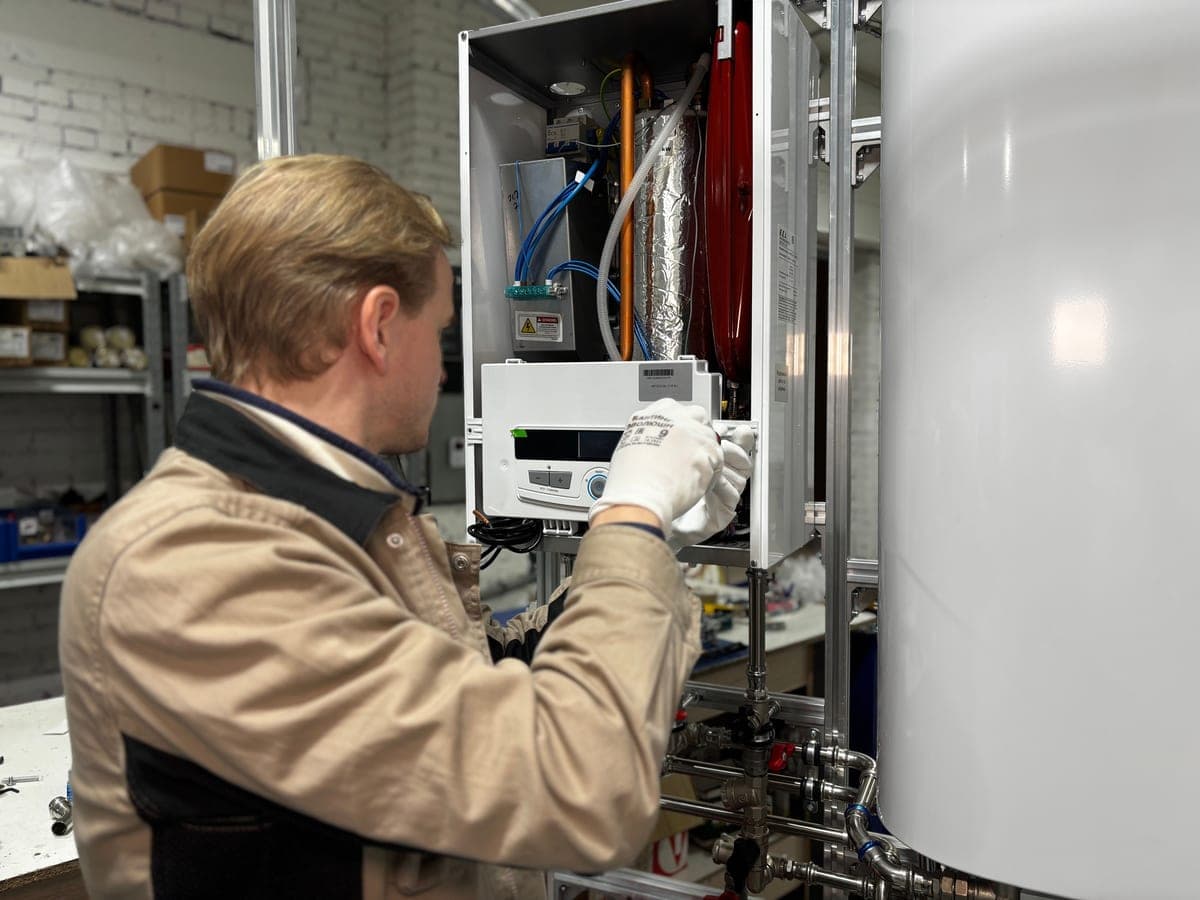
Size on first hour rating, not gallons. ENERGY STAR defines first hour rating as an estimate of the maximum volume of hot water in gallons a storage water heater can supply within an hour starting fully heated. Work out your peak hour of use - the hour when the most hot water is drawn - and pick a unit whose rating meets it. A tankless unit is sized on flow rate in gallons per minute instead.
Why Gallons Is The Wrong Number
Almost everyone sizes a water heater by tank capacity, because that is the number on the front of the box and the number the old unit had. It is a poor guide, and it is the reason households replace a 50-gallon heater with another 50-gallon heater and still run out of hot water.
The problem is that a tank does not deliver its capacity. As hot water leaves the top, cold water enters the bottom, and the two mix - so a 50-gallon tank does not give you 50 gallons of hot water, it gives you some smaller amount of usable hot water plus whatever the burner or elements can reheat while you are drawing. That second part is recovery, and it varies enormously: a gas burner puts far more energy into the tank per hour than a pair of electric resistance elements, which is why a 40-gallon gas unit often serves a household that struggles on a 50-gallon electric.
The industry's answer to this is a single combined figure. ENERGY STAR defines first hour rating as an estimate of the maximum volume of hot water in gallons that a storage water heater can supply within an hour, noting that it begins with a fully heated unit and is measured at a 125 degree Fahrenheit outlet temperature. It bundles usable capacity and recovery into one number, which is exactly what you want when the question is whether three consecutive showers will work.
For a sense of where certified equipment sits, ENERGY STAR's own criteria require a first hour rating of at least 51 gallons per hour for qualifying gas-fired storage water heaters and at least 45 gallons per hour for qualifying electric heat pump water heaters. Those are certification thresholds rather than recommendations for your house - but they show that the figure exists, is published per model, and is comparable across fuel types in a way tank size is not.
Work Out Your Peak Hour
The right size is the one whose first hour rating covers your busiest hour of hot water use - not your daily total, and not an average. Most households have one obvious peak: weekday mornings, or the stretch after dinner. Think about that hour specifically and count what actually happens in it.
- Pick your heaviest hour. For most families it is a weekday morning; for some it is evening when showers, dishes and laundry overlap. Choose the realistic worst case, not the quiet average.
- Count the showers in that hour, and be honest about length. Showers are the dominant draw in nearly every household, and a long shower is a large fraction of a tank on its own.
- Add the other fixtures that genuinely run in that same hour - a bath, the dishwasher, a clothes washer on warm, hand and face washing, shaving, food preparation.
- Note anything unusual about your fixtures. A soaker tub, a large or multi-head shower, or a high-flow shower head changes the arithmetic substantially, and a big tub is the single most common reason a conventionally sized heater disappoints.
- Think about simultaneity rather than sequence. Two showers at once is a different demand from two showers back to back, and the back-to-back case is where recovery rate rescues you.
- Add headroom for how the household will change. If teenagers are coming, or you are adding a bathroom, size for that rather than for today.
- Then compare against the first hour rating on the EnergyGuide label of the units you are considering - not the gallon capacity. Ask your plumber for the figure if the spec sheet is not to hand.
Published Installation Figures By Tank Size (With Sources)
Sizing has a cost dimension, so it is worth seeing what the published figures look like across capacities before deciding to go larger. We are a free referral service, not a plumbing company - we do not set prices and we never publish a price as our own. These are published national figures from an independent cost-data publisher, named and linked with the date it was updated.
| Service | Published national figure |
|---|---|
| 30 gallon, installedFixr.com, Cost to Install a Water Heater, updated January 27, 2026 | $550 - $2,100 |
| 40 gallon, installedFixr.com, updated January 27, 2026 | $550 - $2,300 |
| 50 gallon, installedFixr.com, updated January 27, 2026 | $700 - $2,500 |
| 75 gallon, installedFixr.com, updated January 27, 2026 | $1,100 - $3,400 |
| 80 gallon, installedFixr.com, updated January 27, 2026 | $1,200 - $3,600 |
| Water heater installation - overallFixr.com, updated January 27, 2026; national average given as $1,400 | $900 - $3,000 |
| Tankless, installedFixr.com, updated January 27, 2026; page notes tankless models typically cost nearly twice as much as tank models | $1,000 - $4,000 |
| PermitFixr.com, updated January 27, 2026; higher where new gas lines, electrical work or major plumbing changes are required | $25 - $1,500 |
These are national figures published by Fixr.com on the date shown - not Dallas Best Plumber's prices, not a quote, and not specific to Dallas-Fort Worth. Going up in capacity can also mean a larger gas line, a bigger flue, a different electrical circuit or a unit that no longer fits the space, none of which is in these figures. We are a free referral service, we do not set prices and we do not perform work.
Sources: Fixr.com - Cost to Install a Water Heater (updated January 27, 2026); ENERGY STAR - Water Heaters Key Product Criteria
Sizing A Tankless Unit Is A Different Calculation
If you are considering tankless, the sizing question changes completely. There is no tank, so there is no capacity and no first hour rating - there is only flow rate, measured in gallons per minute, and the temperature rise the unit can hold at that flow.
Those two things trade against each other, which is the key insight. Any demand heater can deliver a high flow at a small temperature rise or a low flow at a large one. ENERGY STAR expresses its criteria accordingly: for gas-fired instantaneous water heaters it requires a maximum flow of at least 2.8 gallons per minute over a 67 degree Fahrenheit rise, and it defines the gallons-per-minute figure as the hot water flow an instantaneous heater can supply while holding a nominal temperature rise.
So sizing tankless means adding up the flow of the fixtures you expect to run at the same time, and then checking the unit delivers that flow at the temperature rise your incoming water actually requires. Incoming water temperature is seasonal - a unit that handles two simultaneous showers comfortably in August may not in a cold January, because the rise required is larger. That seasonal shortfall is the most common complaint about an undersized tankless installation, and it is entirely a sizing error rather than a product fault.
Two practical consequences. First, be realistic about simultaneity - a tankless unit sized for one shower is fine until someone starts the dishwasher. Second, a larger gas-fired tankless unit frequently needs a bigger gas line and a new vent, which is cost that sits outside the appliance price; ENERGY STAR also notes an eligibility size limit for instantaneous units of no more than one gallon of water per 4,000 Btu per hour of input, with input under 200,000 Btu per hour for gas-fired units.
What Else Constrains The Size
Peak hour demand tells you the size you want. Several practical things decide the size you can actually have, and it is better to find them out before you buy.
- Physical space. A larger tank is taller and wider, and a great many water heaters in this market live in a closet, a garage alcove or an attic platform sized for the original unit. Measure, including the clearance above for the flue and the pan beneath.
- The pan and the drain. A replacement has to sit in a pan with a drain line, and that is inspected. An attic installation makes this non-negotiable, because a leak there comes through the ceiling below.
- Gas capacity, if gas. A bigger burner needs a line sized for the bigger load, and the existing line may not be. This is the most common hidden cost in going up a size.
- Venting. A larger gas unit may not work on the existing flue, and where a natural-draft vent will not serve, power venting is an added cost.
- Electrical capacity, if electric. A larger or higher-recovery electric unit needs an adequate circuit, and panel space.
- A heat pump water heater needs air volume and condensate drainage, and is taller than a conventional tank of the same capacity. Good in a garage, often impractical in a small interior closet.
- An expansion tank, which code-compliant installations in this area generally require on a closed system.
- Hard water. The North Texas Municipal Water District describes its treated water as moderately hard, and the City of Mesquite publishes an average of 93 to 134 milligrams per liter for its own supply, which it converts to roughly 5.44 to 7.84 grains per gallon. Scale settles as sediment in a tank and coats a tankless heat exchanger, so annual flushing matters here whatever size you choose.
Bigger Is Not Automatically Better
There is a real temptation to oversize on the theory that it can only help. It is not free, and it is worth knowing what you are buying.
A larger tank costs more to buy and install - Fixr's published figures run from $550 to $2,100 for a 30-gallon unit to $1,200 to $3,600 for an 80-gallon - and it keeps a larger volume of water hot around the clock whether you use it or not. It takes more room, which may be room you do not have. And going up a size frequently triggers the infrastructure items above: a bigger gas line, a different vent, a new circuit. Those are usually a larger cost than the appliance difference.
The better approach is to size to a realistic peak hour with sensible headroom, and to use first hour rating to get there rather than gallons - because a higher-recovery unit of the same tank size often solves the problem without any of the knock-on costs. That is also why gas versus electric and tank versus tankless are worth settling alongside the sizing question rather than after it; our guides on gas versus electric water heaters and tankless versus tank cover those trade-offs.
Finally, if your current heater genuinely never runs short, you have your answer and the sizing exercise is already done - match the first hour rating of what you have and spend the attention on efficiency, warranty and a code-compliant installation instead.
Dallas Best Plumber is a free referral service, not a plumbing company. Tell us how many people are in the house, how many bathrooms, whether you have a large tub, where the heater lives and whether you currently run out of hot water, and we put your request in front of licensed, insured local plumbers who size and install water heaters, with a free, no-obligation quote. The recommendation and the price are theirs - we never set either.
Still stuck? Get matched with a licensed local pro
We'll connect you with a licensed, insured plumber in the Dallas-Fort Worth area for a free, no-obligation quote.
Related guides
- Gas vs Electric Water HeaterFor most homeowners the choice is already made by what is in the wall. Here is how to tell, and when switching is worth the extra work.
- Tankless vs Tank Water Heater: How To ChooseTwo different products solving the same problem. Here is the honest comparison, including the hard-water catch.
- How Long Do Water Heaters Last?Typical service life, what shortens it in North Texas, and the signs that mean you are shopping rather than repairing.
Frequently asked questions
What size water heater do I need for a family of four?
Size it on your peak hour rather than a household headcount, because two families of four can differ by a factor of two. Count the showers, baths, dishwasher and laundry that genuinely overlap in your busiest hour, then pick a unit whose first hour rating covers it. ENERGY STAR defines that rating as the maximum gallons a storage heater can supply within an hour starting fully heated - it is the number to compare.
What is first hour rating and why does it matter more than gallons?
It is the maximum volume of hot water in gallons a storage heater can supply in one hour starting fully heated, measured at a 125 degree Fahrenheit outlet temperature per ENERGY STAR. It matters more than tank size because it includes recovery - how fast the unit reheats while you are drawing. That is why a 40-gallon gas heater often serves a household that runs short on a 50-gallon electric.
Is a bigger water heater always better?
No. A larger tank costs more to buy and install - Fixr's published figures run from $550 to $2,100 for a 30-gallon unit up to $1,200 to $3,600 for an 80-gallon - keeps more water hot around the clock, and takes space you may not have. Going up a size also often means a larger gas line, a different vent or a new circuit. A higher-recovery unit of the same size frequently solves the problem instead.
How do I size a tankless water heater?
On flow rate, not capacity. Add up the gallons per minute of the fixtures you expect to run simultaneously, then confirm the unit delivers that flow at the temperature rise your incoming water requires - and remember incoming water is colder in winter, so the rise is larger then. ENERGY STAR's criteria for gas-fired instantaneous units require at least 2.8 gallons per minute over a 67 degree rise.
Can I just replace my water heater with the same size?
If you never run short of hot water, that is a perfectly good decision - match the first hour rating rather than just the gallons, and spend your attention on efficiency, warranty and a code-compliant install with a pan, drain and expansion tank. If you do run short, or the household has grown since it was installed, do the peak hour exercise instead of repeating the previous choice.