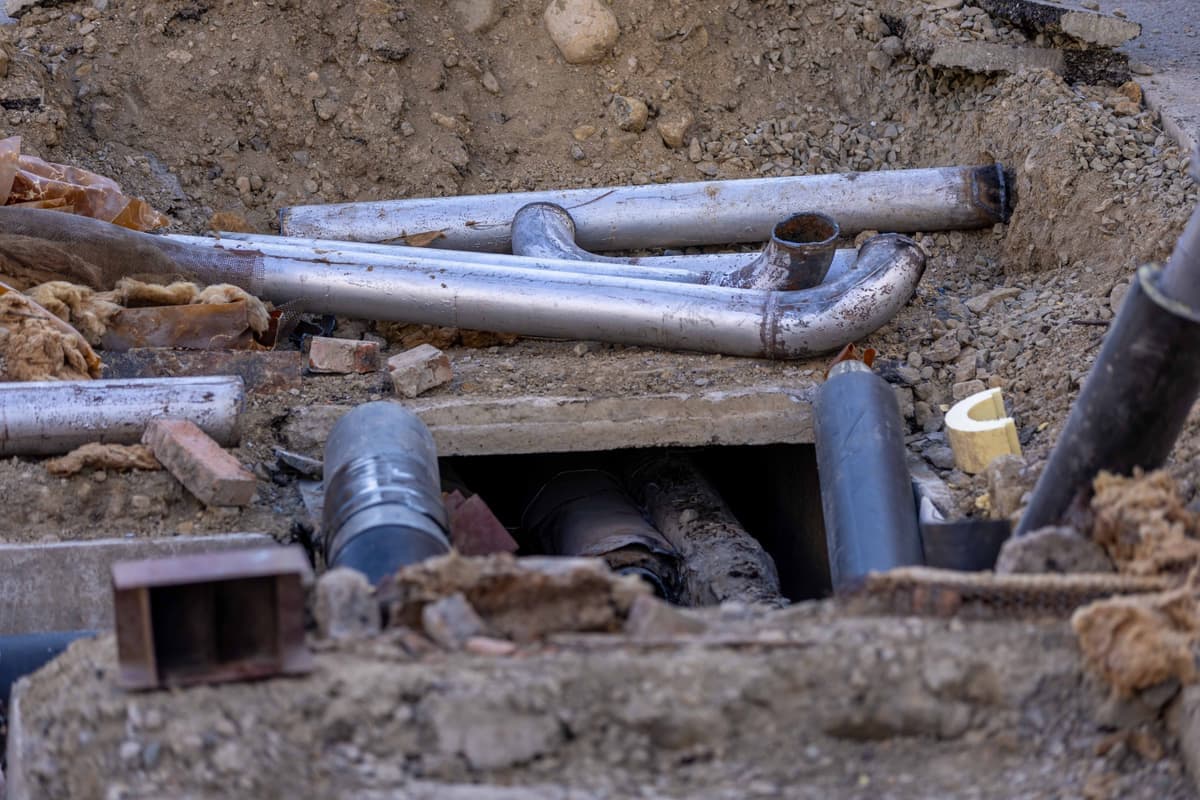
Cast iron drain pipe fails by corroding from the inside: rust eats through the wall and scale narrows the bore until the line blocks or leaks. For a sewer line, This Old House publishes cast iron at $800 to $3,000 for 40 linear feet and sewer line replacement overall at $1,390 to $5,320. In a Dallas-area slab home the options are a spot repair, trenchless lining, tunneling, or breaking the slab to replace the run in PVC.
Why Cast Iron Fails
Cast iron was the standard for residential drain, waste and vent piping for decades, and it is still in a great many Dallas-area homes built before the 1970s. Bob Vila's guide to plumbing pipe types, updated July 24, 2026, describes it as common in old homes and large commercial buildings, historically used for both water and drain lines and now found as drain, waste and vent piping and main sewer stacks in older buildings. It notes that cast iron is vulnerable to rust buildup and corrosion that eats through the pipes and causes leaks, and that old homes often used lead joints to lock sections together.
The mechanism is corrosion from the inside. Wastewater, and particularly the hydrogen sulfide that forms above the flow line in a drain, attacks the iron. Rust scale builds on the inner wall while the wall itself thins. Two things happen at once: the usable diameter shrinks, so the line blocks more easily, and the metal gets weaker until it cracks or a section fails completely.
That is why cast iron is deceptive. From the outside, a pipe that has lost most of its wall thickness looks like a pipe. The only reliable way to see the condition is from the inside, with a camera - which is why a camera inspection is the first step in almost every cast iron decision rather than a nice-to-have.
The scale also explains the symptom pattern. A cast iron line that has narrowed will clog repeatedly in the same place, because the constriction is permanent. Clearing it restores flow through a smaller pipe; it does not give you the pipe back.
- Internal rust scale narrowing the bore, so clogs recur in the same spot.
- Wall thinning from the inside, invisible externally, ending in cracks or a failed section.
- Hydrogen sulfide corrosion concentrated above the flow line, which is why the top of the pipe often fails first.
- Joint failures, including old lead-caulked joints in the oldest installations.
- Bellies and sags where soil movement has pulled a heavy pipe out of grade and solids now settle.
- Root intrusion through cracks and failed joints, drawn by the moisture escaping.
Signs Your Cast Iron Is Going
Cast iron gives warnings, but they are the kind people live with for years before connecting them. The pattern is recurrence and multiplicity: the same problem in the same place, or several fixtures misbehaving together.
- Repeated clogs in the same drain or the same section of the main line, especially if clearing works for a while and then stops working for as long.
- Multiple drains slow at once, which points at the main line rather than a branch.
- Gurgling toilets or drains when another fixture runs, which is air moving past a restriction.
- A persistent sewer or sulfur smell with no obvious dry trap to blame. Our guide on a sewer smell in the house covers how to rule out the simple causes.
- Dark staining, rust flakes or gritty debris in the water when a drain backs up.
- Damp or discolored patches on a slab floor or at the base of a wall, which can mean a drain line is leaking under the concrete.
- Unexplained insect or rodent activity, since a broken drain under a slab is an entry route.
- Any of the above in a home built before roughly 1970 that has never had its drains scoped.
The Options in a Slab Home
This is where cast iron differs from a supply line problem, and it is the most important thing to understand before reading a quote.
A supply line can be rerouted. If copper under your slab is failing, a plumber can abandon the under-slab run and reroute new pipe overhead through the attic, because pressurized water does not care which way it travels. Drains do not work that way. Drain and waste lines move by gravity and must hold a continuous fall, so you cannot simply route them through the attic. The line has to stay broadly where it is, at the grade it needs.
That constraint produces four realistic approaches, and which one applies depends on what the camera shows and where the failure is.
A spot repair opens one location - through the slab or by tunneling - and replaces a short failed section. It is appropriate when the camera shows a single defect in a line that is otherwise sound, which on genuinely old cast iron is less common than people hope.
Trenchless lining, often called cured-in-place pipe, pulls a resin-saturated liner through the existing pipe and cures it to form a new jointless pipe inside the old one. It avoids most of the demolition, and because the result has no joints it also removes the route roots were using. It needs a host pipe in good enough shape to line, which again is a camera question.
Tunneling goes in from outside and works under the slab to reach and replace the pipe, leaving your floors intact. It costs more in labor than cutting through the floor but far less in interior restoration, and on a finished house it is often the better trade.
Breaking the slab is the conventional answer: cut the concrete inside the house, remove the failed cast iron, replace it in PVC, backfill and repour. It gives the most certain result and it is the most disruptive, because flooring comes up and the work happens in your living space.
- Spot repair: cheapest, right only when a single defect sits in otherwise sound pipe.
- Trenchless lining: creates a new jointless pipe inside the old one, minimal demolition, requires a linable host pipe.
- Tunneling: works under the slab from outside, keeps floors intact, higher labor cost than cutting in.
- Break the slab and replace in PVC: most certain and most disruptive, and usually the answer when the whole run is gone.
- Not an option for drains: rerouting overhead. Gravity drains must keep their fall, which is the opposite of the standard answer for a failing supply line.
- Always first: a camera inspection. Every one of these choices depends on what the inside of the pipe looks like.
Published Cost Figures (With Sources)
Dallas Best Plumber is a free referral service. We do not set prices, we do not perform work, and nothing below is our quote. These are figures published by independent sources, named and dated. Cast iron work is quoted by the foot far more often than as a flat job, so the per-foot rows matter as much as the totals.
Watch the distinction between materials-only and installed figures. Fixr's cast iron per-foot number is for materials; the installed per-foot figures are much higher because they include the labor and, under a slab, the access.
| Service | Published figure |
|---|---|
| Cast iron sewer pipe - 40 linear feetThis Old House, Sewer Line Replacement Cost, updated March 30, 2026; given in the page's key takeaways for cast iron over 40 linear feet | $800 - $3,000 |
| Cast iron pipe repair - materials only, per linear footFixr.com, Cost to Repair a Drain Line Breakage, updated January 31, 2025; materials, not installed | $10 - $30 / foot |
| Sewer line replacement - overallThis Old House, updated March 30, 2026; average given as $3,320 | $1,390 - $5,320 |
| Sewer line replacement - per linear foot installedThis Old House, updated March 30, 2026; traditional excavation $50 to $200 per foot, trenchless $60 to $250 per foot | $50 - $250 / foot |
| PVC replacement pipe - materialsThis Old House, updated March 30, 2026; the usual replacement material for failed cast iron. ABS given as $120 to $440 | $120 - $320 |
| Drain line breakage repair - overallFixr.com, updated January 31, 2025; national average $600, with a $150 low end for a small break inside a wall and a high end up to $5,000 | $400 - $1,500 |
| Pipe under a slab - repair totalFixr.com, updated January 31, 2025 | $500 - $4,500 |
| Pipe replacement where excavation is requiredFixr.com, updated January 31, 2025; the page says pipe replacement starts at $100 per foot and reaches $650 per foot with excavation, and gives $50 to $250 per foot for dig-and-replace. Excavation itself adds around $1,000 | Up to $650 / foot |
| Collapsed pipeFixr.com, updated January 31, 2025 | $50 - $300 / linear foot |
| Camera inspection (the step that comes first)This Old House, updated March 30, 2026. Fixr.com, updated January 31, 2025, says video inspection adds $200 to $400 to a drain line project, or $250 to $400 where the pipe runs under the house | $100 - $500 |
| Tree root removal, if roots have entered the failed pipeThis Old House, updated March 30, 2026 | $80 - $1,000 |
| PermitsThis Old House, updated March 30, 2026; in Texas, permitting is handled by your city rather than the state | $100 - $1,000 |
| Labor - hourlyFixr.com, updated January 31, 2025, with most plumbers around $120 per hour. This Old House, updated March 30, 2026, notes $150 to $500 per hour specifically for sewer work | $45 - $200 / hour |
These are published figures from This Old House (updated March 30, 2026, cost data from Angi unless otherwise noted) and Fixr.com (updated January 31, 2025). They are national, not Dallas-Fort Worth specific, not Dallas Best Plumber's prices and not a quote. Materials-only and installed figures are labeled separately and should not be compared directly. Interior restoration - flooring, concrete and finishes - is usually a separate cost from the plumbing. We are a free referral service: we do not set prices and we do not perform work.
Sources: This Old House - Sewer Line Replacement Cost (updated March 30, 2026); Fixr.com - Cost to Repair a Drain Line Breakage (updated January 31, 2025); Bob Vila - 11 Types of Plumbing Pipes (updated July 24, 2026)
Why This Lands Hard in Older Dallas Neighborhoods
Cast iron is a national issue that is sharper in North Texas, for three reasons that compound each other.
The housing stock is the first. Established neighborhoods across East Dallas, Oak Cliff, Richardson, Garland, Mesquite, Irving and the older parts of Plano and Carrollton were built when cast iron was the standard drain material. Those lines are now decades into a corrosion process that runs on a schedule.
The slab is the second. With no basement and usually no crawl space, the drain lines run under or inside the concrete. That removes the easy access a basement home has, turns every repair into a concrete and restoration question, and rules out the overhead reroute that solves failing supply lines.
The soil is the third, and it is the local multiplier. Expansive North Texas clay swells with moisture and shrinks in drought, and the Dallas climate delivers that cycle hard. Heavy rigid cast iron laid at a precise fall does not ride that movement well: joints work apart, sections offset, and the line develops bellies where water and solids stand. Standing water in a cast iron pipe accelerates exactly the corrosion that is already thinning the wall.
Trees finish it. Once a joint has opened or the wall has cracked, the mature canopy in those same older neighborhoods sends roots toward the moisture, and a root mat in a narrowed pipe is a blockage waiting for a holiday weekend. Our guide on tree roots in a sewer line covers that cycle.
Before You Approve a Cast Iron Quote
Cast iron replacement is one of the larger residential plumbing jobs, and quotes for it are frequently not comparable because they describe different methods and different scopes. These questions fix that.
- Insist on a camera inspection first, and ask to see the footage or stills. Every method decision depends on the condition of the pipe, and you should not be buying a plan nobody has looked at.
- Ask how much of the run is actually failing, with distances. A quote for the whole line when the camera shows one bad section is a different job from the one you need.
- Ask which method is proposed and why: spot repair, lining, tunneling, or breaking the slab. Then ask what the next-best option would cost, so you can see the trade.
- Ask what is included in restoration. Concrete, flooring, tile and paint are commonly outside a plumbing quote, and that is where two numbers diverge most.
- Ask who pulls the permit and whether the inspection is included. Permitting is handled by your city.
- Ask how many days, whether the house is usable during the work, and whether the bathrooms will be out of service.
- Ask about the warranty on both pipe and labor, in writing on the contract.
- Get a second quote on anything in the thousands, and make sure both describe the same method on the same length of pipe.
Get Matched With a Licensed Dallas-Area Plumber
Dallas Best Plumber is a free referral service, not a plumbing company. Tell us roughly when the house was built, what the drains are doing and whether the line has ever been scoped, and we match you with a licensed, insured plumber serving your ZIP who can camera the line and quote the work honestly. The match is free and there is no obligation to hire.
If you are at the beginning of this, the most valuable next step is almost always the camera, not the quote. Our sewer camera inspection cost guide covers the published figures for that, and our sewer line replacement cost guide covers the figures if the footage shows the run is finished.
In Texas, plumbing work must be performed by a licensed plumber, and you can verify any license yourself through the Texas State Board of Plumbing Examiners public license search. On a job that involves cutting your foundation, that check is worth the two minutes - our Texas plumbing license lookup guide shows how.
Still stuck? Get matched with a licensed local pro
We'll connect you with a licensed, insured plumber in the Dallas-Fort Worth area for a free, no-obligation quote.
Related guides
- Sewer Camera Inspection CostThe cheapest money you can spend on a sewer line, because it is the only thing that tells you whether the next quote should be a cleaning or a replacement.
- Sewer Line Replacement CostThis is the plumbing job with the widest spread of any - and almost all of it comes down to length, depth, and what is on top of the pipe.
- Tree Roots in a Sewer Line: Signs, Fixes and CostsRoots do not break into a good pipe. They follow water out of a pipe that is already cracked - which is why cutting them is a trim, not a cure.
- Polybutylene Pipe ReplacementGray, blue or black flexible plastic stamped PB2110. If that is what feeds your fixtures, the question is when to replace it, not whether.
- Repipe House CostThe pipe is the cheap part. Most of a repipe quote is labor, access and putting your walls back - which is why the published spread is so large.
Frequently asked questions
How much does cast iron pipe replacement cost?
This Old House publishes cast iron sewer pipe at $800 to $3,000 for 40 linear feet and sewer line replacement overall at $1,390 to $5,320 with a $3,320 average, or $50 to $250 per linear foot installed. Fixr.com gives $10 to $30 per linear foot for cast iron materials only and $500 to $4,500 for a pipe-under-slab repair. Those are published national figures, not our prices and not a quote.
How long does cast iron pipe last?
Neither source we cite publishes a lifespan figure, so we will not invent one. What is documented is the mechanism: Bob Vila describes cast iron as vulnerable to rust buildup and corrosion that eats through the pipes. Condition depends on what has been running through it and how wet the surrounding soil stays, which is why a camera inspection tells you more than the installation date does.
Can cast iron pipe be lined instead of replaced?
Often yes. Trenchless lining pulls a resin-saturated liner through the existing pipe and cures it into a new jointless pipe inside the old one, which avoids most of the demolition and also removes the joints roots were using. It requires a host pipe in good enough condition to line, so the camera inspection decides whether it is an option for your run.
Why can't you just reroute a cast iron drain line overhead?
Because drains run by gravity and must hold a continuous fall. That is the key difference from a failing water supply line, which can be rerouted overhead through the attic since pressurized water does not care about grade. A drain has to stay broadly where it is, which is why cast iron under a slab means tunneling, lining, or opening concrete.
What are the signs cast iron drain pipe is failing?
Clogs that recur in the same place, several drains slowing at once, gurgling when another fixture runs, a persistent sewer smell, rust flakes or gritty debris in a backup, and damp or discolored patches on a slab floor. On a home built before roughly 1970 with any of those and no history of being scoped, a camera inspection is the obvious next step.
Should I replace cast iron before selling a house?
That is a financial judgment rather than a plumbing one, but know that a buyer's inspection or a sewer scope will find it, so it becomes a negotiation either way. Having the line scoped yourself puts you in the stronger position: you know what the footage shows before a buyer's inspector tells you, and a documented lining or replacement is a cleaner answer than a disclosure.