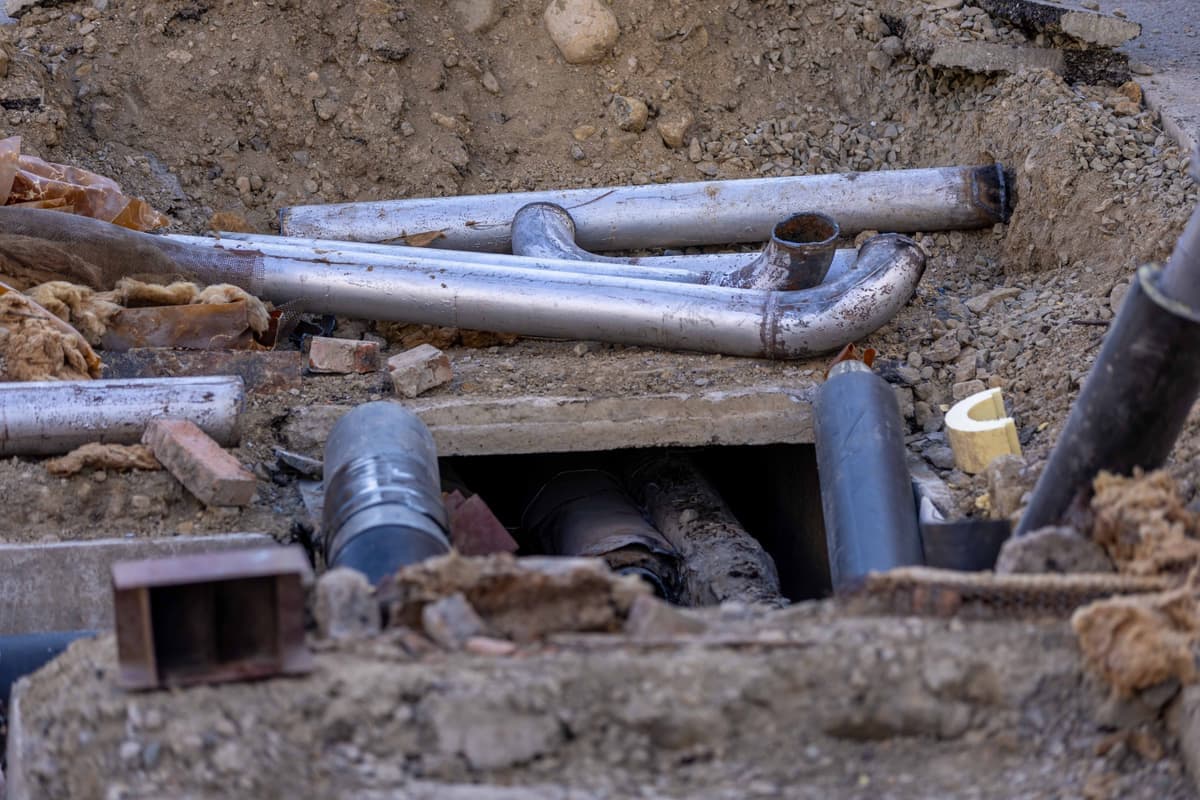
Published figures vary widely because the job does. Bob Vila reports a typical range of $1,253 to $4,701 with a national average of $2,914, and $50 to $250 per linear foot. Inch Calculator's guide gives $60 to $250 per linear foot, with short repairs around $2,500 and long ones reaching $25,000. Length, depth, access and surface restoration drive nearly all of the difference.
Published Sewer Line Figures (With Sources)
We are a free referral service, not a plumbing company - we do not set prices and we never publish a price as our own. Below is what independent cost publishers report nationally, named and linked, with the date each was last updated. They disagree substantially, and that disagreement is the most useful thing on this page: it tells you this is a job where the site, not the pipe, sets the price. Anyone who quotes you a sewer replacement without looking at the line is guessing.
| Service | Published national figure |
|---|---|
| Sewer line replacement - typical rangeBob Vila, Sewer Line Replacement Cost, updated January 27, 2023; national average given as $2,914 | $1,253 - $4,701 |
| Replacement, per linear footBob Vila, updated January 27, 2023; the guide notes most jobs fall at $50 to $125 per foot | $50 - $250 |
| Sewer line, per linear footInch Calculator, Cost to Hire a Plumber - 2026 Price Guide; short repairs put at about $2,500, longer runs reaching $25,000 | $60 - $250 |
| Trenchless replacement, per linear footBob Vila, updated January 27, 2023 | $60 - $250 |
| Cured-in-place pipe lining (CIPP), per footBob Vila, updated January 27, 2023 | $80 - $250 |
| Pipe bursting, per footBob Vila, updated January 27, 2023 | $60 - $200 |
| Line running under a concrete slab, per footBob Vila, updated January 27, 2023 | $300 - $350 |
| Trenching / excavation, per 100 linear feetBob Vila, updated January 27, 2023 | $400 - $1,200 |
| House-to-street lineBob Vila, updated January 27, 2023 | $530 - $2,270 |
| Section replacement of a main sewer lineFixr.com, Cost to Clean Sewer Line, updated January 31, 2025 | $1,000 - $20,000 |
| Sewer camera / video inspectionBob Vila, updated January 27, 2023; Fixr.com puts it at $300 to $600 (updated January 31, 2025) | $100 - $500 |
| PermitBob Vila, updated January 27, 2023; varies by municipality | about $200 |
These are national figures published by third-party cost sites on the dates shown - not Dallas Best Plumber's prices, not a quote, and not specific to Dallas-Fort Worth. The Bob Vila figures date from January 2023 and should be read as older data. We are a free referral service, we do not set prices and we do not perform work. Your matched licensed local plumber gives you the actual free, no-obligation quote after a camera inspection.
Sources: Bob Vila - How Much Does Sewer Line Replacement Cost? (updated January 27, 2023); Inch Calculator - Cost to Hire a Plumber, 2026 Price Guide; Fixr.com - Cost to Clean Sewer Line (updated January 31, 2025)
Why The Range Is So Wide
A sewer line replacement can be a one-day job in a side yard or a two-week job across a driveway, and the published averages average those together. These are the variables that decide which one you have.
- Length. The per-foot figures multiply. A thirty-foot run from the house to a cleanout and a hundred-foot run to a street main are different projects before anything else is considered.
- Depth. Deeper pipe means more spoil, more shoring, and sometimes a different machine. Depth is set by the fall required to the main and it is not negotiable.
- What is on top of it. Lawn is cheap to put back. A driveway, a patio, mature trees, a pool deck or a sidewalk are not, and the restoration can rival the plumbing. This is the item most often missing from a cheap-looking quote.
- Whether it runs under the slab. Bob Vila puts a line under a concrete slab at $300 to $350 per foot against $50 to $125 for a typical run - the highest multiplier in the whole job, and a very common situation in this market, where most houses are slab-on-grade.
- Method. Trenchless lining or pipe bursting costs more per foot than open-cut but digs far less, so the total can land lower once restoration is counted. Bob Vila puts CIPP lining at $80 to $250 per foot and pipe bursting at $60 to $200.
- Pipe material going in, and what is coming out. The same guide prices PVC at $73 to $376 per 48 linear feet against cast iron at $1,104 to $3,600 - most residential replacements go back in PVC.
- Where the responsibility line falls. The Insurance Information Institute states plainly that the sewer lateral is owned and maintained by the property owner, including any part that extends into the street or public right of way - so the portion in the parkway is usually yours, and work in the right of way needs its own permitting and traffic control.
- Permit and inspection. Bob Vila puts the permit at about $200, varying by municipality, and in this area that means Dallas, Plano, Garland, Richardson, Irving, Mesquite, McKinney or whichever city has jurisdiction.
Trenchless Or Dig?
Trenchless is not automatically cheaper and it is not always possible, so treat anyone who presents it as the obvious answer with some caution. There are two main methods and they solve different problems.
Cured-in-place pipe lining pulls a resin-saturated liner through the existing pipe and cures it in place, creating a new pipe inside the old one. It needs the host pipe to be structurally continuous and reasonably in grade - a line that has collapsed, or one that has sagged into a belly, cannot be lined, because the liner follows the old pipe's shape including its fault. Bob Vila puts it at $80 to $250 per foot.
Pipe bursting pulls a new pipe through while fracturing the old one outward. It handles a line that is cracked or root-damaged, works through a single pit at each end, and leaves a full-diameter new pipe. Bob Vila puts it at $60 to $200 per foot. It needs room for the pits and clearance from other buried utilities.
Open-cut excavation remains the right answer more often than trenchless marketing suggests: a short run, a shallow line, an accessible yard, a line with a belly that needs re-grading, or a replacement that also needs new fittings or a cleanout added. The per-foot number is lower, and if the surface above is grass the restoration is minor.
The deciding input is the camera inspection, and it should come before any method is chosen. Bob Vila puts a camera inspection at $100 to $500 and Fixr at $300 to $600. That is the cheapest money in this entire project, because it is what determines whether you are buying a spot repair, a lining, a burst or a full dig - and the difference between those is thousands of dollars.
Spot Repair Versus Full Replacement
The most expensive mistake in sewer work is replacing a whole line when one joint has failed, and the second most expensive is spot-repairing a line that is failing everywhere. The camera tells you which situation you are in, and a good contractor will show you the footage and the distance markers rather than describing it.
A spot repair is appropriate when the camera shows a single discrete defect - one offset joint, one root intrusion at one coupling, one crushed section where something was driven over it - with the rest of the line sound and in grade. Bob Vila lists a cracked pipe replacement at an average of $1,050 and tree root removal at $100 to $600 not including pipe repair.
Full replacement becomes the better value when the camera shows the whole run is at the end of its life: a cast-iron line scaled and channeled along its length, a clay line with root intrusion at most joints, or a line with multiple bellies where the grade has been lost. Fixing one defect in that pipe buys you a year. This is where build era matters: clay and cast iron were standard in older Dallas, Garland, Richardson and Mesquite neighborhoods, and both have finite lives, while PVC became common later.
A belly - a sagging section that holds water - deserves its own mention, because it is common in this region and it cannot be lined away. Expansive clay soils across the Dallas area shrink and swell with moisture, and over decades that movement pulls a buried line out of grade. The pipe is intact but it no longer drains, so solids settle in the low spot and it blocks repeatedly. The only real fix is excavating that section and re-laying it to proper fall.
What To Ask For In A Quote
Sewer quotes are the hardest in residential plumbing to compare, because contractors scope restoration and contingencies differently and the cheap one is frequently cheap because something is excluded. Ask every bidder for the same list.
- The camera footage, with distance markers, and the specific defects identified at specific distances. Ask for a copy.
- The measured length and depth of the work, and the method proposed, with the reason that method was chosen over the others.
- What surface is being disturbed and exactly who restores it to what standard - concrete, pavers, irrigation, sod, fencing, trees. Get this in writing; it is the most common gap.
- Whether any of the work falls in the public right of way, who permits that, and whether traffic control is included.
- Whether a cleanout is being added or replaced, which is worth having regardless.
- The permit, the inspection, and the final camera run after completion to prove grade and fall.
- The contingency: what happens and what it costs if they find something else once the ground is open.
- The warranty on the pipe and on the labor, separately, and how long it runs.
Before You Spend Anything
Two checks are worth doing before you commit to a number this size. The first is the insurance question, because people assume the answer and are usually wrong. The Insurance Information Institute states that sewer backups are not covered under a typical homeowners insurance policy, nor are they covered by flood insurance, and that the coverage must be purchased either as a separate product or as an endorsement to a homeowners policy, usually at a nominal cost. Separately, a standard policy generally does not pay to replace a worn-out buried pipe at all - that is maintenance - though resulting damage from a sudden failure may be a different matter. Check your own policy and ask your agent directly.
The second is whether the city has any responsibility. The Insurance Information Institute notes the sewer lateral is owned and maintained by the property owner, including the portion extending into the street or right of way, so the usual answer is no - but the connection at the main, and any defect in the city main itself, is not yours. If the camera shows the problem at or beyond the tap, raise it with your city's water department before paying to replace your own line.
Then get more than one quote, and make sure each one is working from the same camera findings. On a job with this much spread, the single highest-value hour you can spend is the inspection.
Dallas Best Plumber is a free referral service, not a plumbing company. Tell us what the line is doing, roughly how long the run is, what is on top of it, and whether anyone has had a camera in it, and we put your request in front of licensed, insured local plumbers who do sewer work, with a free, no-obligation quote. The price is theirs - we never set it and we never perform the work.
Still stuck? Get matched with a licensed local pro
We'll connect you with a licensed, insured plumber in the Dallas-Fort Worth area for a free, no-obligation quote.
Related guides
- Main Sewer Line ClogOne slow drain is a fixture problem. Several at once, with gurgling, is the main line - and the first thing to do is stop running water.
- Hydro Jetting CostIt costs more than snaking because it does more - and on the wrong pipe it is the more expensive mistake. Here is how to tell which you have.
- Does Homeowners Insurance Cover Plumbing?The dividing line is sudden versus gradual, not cheap versus expensive. Knowing which side you are on changes what you do in the first hour.
- Tree Roots in a Sewer Line: Signs, Fixes and CostsRoots do not break into a good pipe. They follow water out of a pipe that is already cracked - which is why cutting them is a trim, not a cure.
- Sewer Camera Inspection CostThe cheapest money you can spend on a sewer line, because it is the only thing that tells you whether the next quote should be a cleaning or a replacement.
- Cast Iron Pipe ReplacementCast iron rusts from the inside out, so the pipe looks fine until it does not. In a slab home, that is the whole problem.
Frequently asked questions
How much does sewer line replacement cost?
Published figures vary widely. Bob Vila (updated January 27, 2023) reports a typical range of $1,253 to $4,701 with a national average of $2,914, and $50 to $250 per linear foot. Inch Calculator's 2026 guide gives $60 to $250 per linear foot, with short repairs about $2,500 and long ones up to $25,000. These are third-party national figures, not our prices and not DFW-specific.
Why are sewer line quotes so different from each other?
Usually because of what is on top of the pipe and what each bidder included for putting it back. Driveways, patios, pool decks, irrigation and mature trees can make restoration rival the plumbing. Depth, length and method matter too - Bob Vila puts a line under a concrete slab at $300 to $350 per foot against $50 to $125 for a typical run. Ask each quote to itemize restoration in writing.
Is trenchless sewer replacement cheaper than digging?
Per foot it is usually more - Bob Vila puts CIPP lining at $80 to $250 and pipe bursting at $60 to $200 against $50 to $125 for a typical open-cut run - but the total can land lower because there is far less surface to restore. It is not always possible: a collapsed line, or one that has sagged into a belly, cannot be lined, because the liner follows the old pipe's shape.
Do I need a camera inspection before replacing a sewer line?
Yes, and it is the best value in the whole project. Bob Vila puts a camera inspection at $100 to $500 and Fixr at $300 to $600 - against a replacement measured in thousands. It is what decides whether you need a spot repair at one joint, a lining, a pipe burst or a full dig, and those differ by thousands of dollars. Ask for the footage with distance markers.
Does homeowners insurance cover sewer line replacement?
Generally not. The Insurance Information Institute states that sewer backups are not covered under a typical homeowners policy nor by flood insurance, and that coverage must be bought as a separate product or an endorsement, usually at a nominal cost. Replacing a worn-out buried pipe is normally treated as maintenance in any case. Read your own policy and ask your agent before assuming either way.