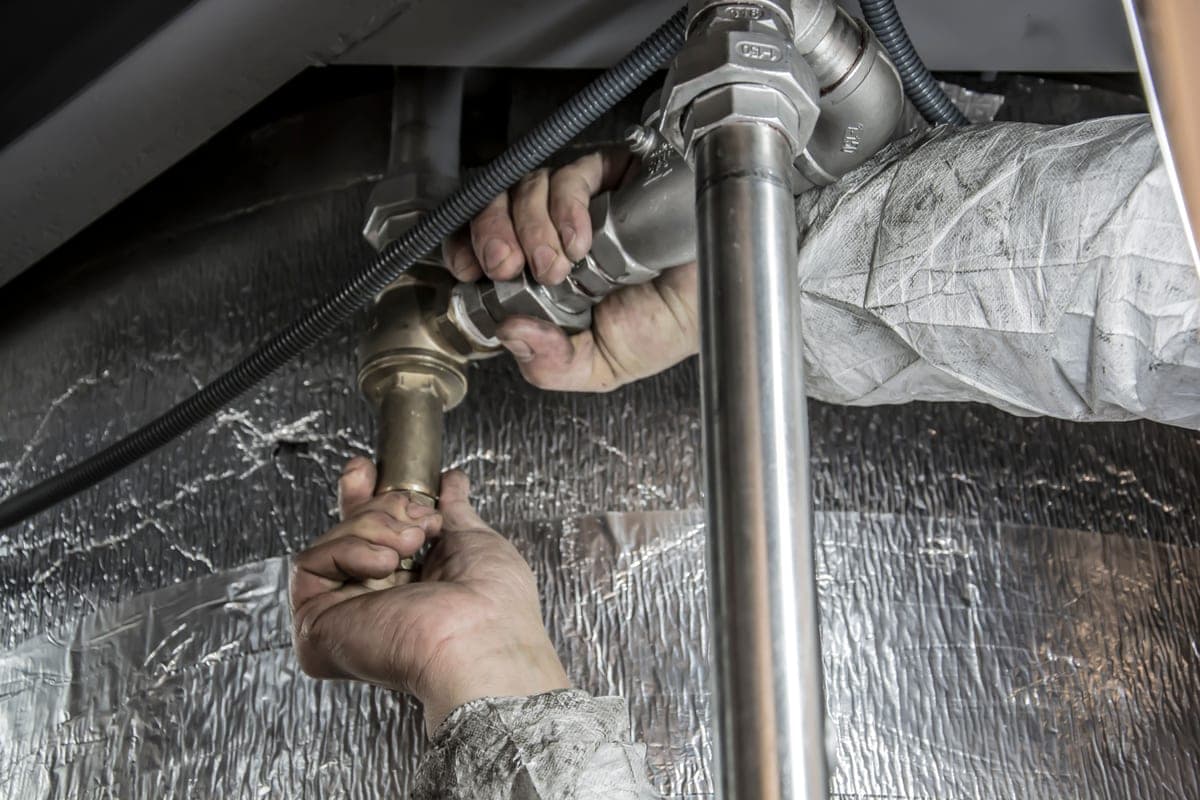
Generally, a standard homeowners policy covers the damage a sudden plumbing failure causes, but not the worn-out pipe itself and not slow leaks. The Insurance Information Institute states the HO-3 form covers accidental discharge of water from a plumbing system, while water seepage is excluded and viewed as a maintenance issue. Sewer backup is not covered at all without a separate endorsement.
The Line That Decides Everything: Sudden vs Gradual
Homeowners usually ask this question with a specific disaster in front of them, and the answer almost always turns on one distinction rather than on the size of the loss. Insurance is designed to cover sudden, accidental events. It is not designed to pay for things wearing out, and it is not designed to pay for damage that accumulated because nobody dealt with a problem.
The Insurance Information Institute - the insurance industry's own public information body, also known as Triple-I - puts both halves of that plainly. On the covered side, its consumer guidance states that the HO-3 covers you for accidental discharge of water from a plumbing system. On the excluded side, it states that water seepage is excluded under the HO-3, and that seepage is viewed as a maintenance issue and is not covered by insurance. It adds that if the water seepage is not due to a flood you will not be covered under a flood policy either.
Translated into real situations: a supply line that lets go and floods a hallway in twenty minutes is the first kind. A shower pan that has been wetting a subfloor for two years is the second. The second one is often the more expensive repair, and it is the one that typically is not paid.
There is a second distinction layered on top, and it catches people out even when the event was sudden. Policies generally pay for the resulting damage - the flooring, the drywall, the contents - rather than for the failed component. A burst pipe claim usually pays to dry the house and repair the ceiling; it usually does not pay for the new pipe, and it will not pay to replace a sewer lateral that has reached the end of its life. That piece is maintenance.
How Common Plumbing Losses Are Usually Treated
The table below summarizes how a standard homeowners form generally treats the plumbing situations people ask about, drawn from the Insurance Information Institute's published consumer guidance, which is named and linked below. It is a general orientation and nothing more: your policy is the document that governs your claim, forms differ, and the broad HO-3 and open-perils forms cover more than a basic HO-1. Read yours, and ask your agent about anything that matters to you before you need it.
| Service | Typical treatment |
|---|---|
| Accidental discharge or overflow of water from a plumbing, heating or air conditioning systemTriple-I: the HO-3 covers you for accidental discharge of water from a plumbing system; the perils list includes accidental discharge or overflow of water or steam from within a plumbing, heating or air conditioning system | Generally covered |
| Freezing of a plumbing, heating, air conditioning or fire sprinkler systemTriple-I, Which disasters are covered by homeowners insurance? - appears in the perils list for the broader forms rather than basic HO-1 | Listed as a covered peril |
| Sudden tearing apart, cracking, burning or bulging of a water heating systemTriple-I, Which disasters are covered by homeowners insurance? | Listed as a covered peril |
| Slow leaks and seepage (a long-running drip, a failing shower pan)Triple-I: water seepage is excluded under the HO-3, and seepage is viewed as a maintenance issue and is not covered by insurance | Excluded |
| Sewer or drain backupTriple-I: sewer backups are not covered under a typical homeowners insurance policy, nor are they covered by flood insurance; coverage must be purchased either as a separate product or as an endorsement to a homeowners policy, usually at a nominal cost | Not covered without an endorsement |
| The worn-out pipe, water heater or sewer lateral itselfTreated as maintenance and wear rather than a sudden accidental loss; policies generally respond to resulting damage, not the failed component | Generally not covered |
| Flood water entering the homeTriple-I: flood damage is excluded under standard homeowners and renters insurance policies; coverage comes from the National Flood Insurance Program or private insurers | Excluded; needs separate flood insurance |
This is general orientation based on the Insurance Information Institute's published consumer guidance, linked below - not legal or insurance advice, not a coverage opinion, and not specific to your policy. Forms and endorsements vary by insurer and by state, and the broader HO-3 and open-perils forms cover more than a basic HO-1. Read your own policy and speak to your agent or insurer. Dallas Best Plumber is a free referral service for plumbing work; we are not an insurer, an adjuster or a broker, and we do not handle claims.
Sources: Insurance Information Institute (Triple-I) - Am I Covered?; Insurance Information Institute (Triple-I) - Which disasters are covered by homeowners insurance?; Insurance Information Institute (Triple-I) - Protect your house from sewer backups
The Sewer Backup Gap
This is the single most common surprise, and it is worth addressing on its own because almost nobody expects it. Sewage coming up through a floor drain or a downstairs shower is one of the worst domestic losses there is - it is category three contaminated water, it affects flooring, drywall, cabinetry and contents, and remediation is specialized. And a standard policy does not cover it.
The Insurance Information Institute is unambiguous: sewer backups are not covered under a typical homeowners insurance policy, nor are they covered by flood insurance, and the coverage must be purchased either as a separate product or as an endorsement to a homeowners policy, usually at a nominal cost. The Institute's sewer backup guidance adds that coverage is available from most providers for a nominal cost.
That combination - severe loss, cheap coverage, usually absent - is why this is worth a phone call to your agent today rather than after the event. Ask specifically for the sewer and drain backup endorsement, ask what limit it carries, and ask whether a separate deductible applies to it, because on this endorsement it often does.
The Institute also notes who owns the pipe, which is the other half of the surprise: the sewer lateral is owned and maintained by the property owner, including any part that extends into the street or public right of way. So in most cases the line from your house to the city main is yours to maintain and yours to replace, and a failure in it is not the city's problem.
One prevention measure is worth knowing about because it addresses the specific scenario of a city main surcharging into your house: a backwater valve, which the Institute describes as a device that, properly installed and maintained, allows sewage to go out, but not to come back in, and which it recommends installing with a qualified plumber. It also advises against connecting French drains, sump pumps and other flood control systems to the sanitary sewer - those connections overload the line in exactly the heavy rainfall most likely to cause a backup.
What To Do In The First Hour - It Affects The Claim
Whatever your coverage turns out to be, the first hour shapes it. Two things matter: stopping the loss, and documenting it. Insurers expect a policyholder to mitigate - that is, to take reasonable steps to stop ongoing damage - and the claim is easier when it is clear what happened and when.
- Shut the water off at the main. Stopping the loss comes before everything else, and it is also the mitigation step an adjuster will ask about.
- Cut power at the breaker to any circuit near standing water, if it is safe to reach the panel. Treat water near electrical equipment or a gas appliance as a safety situation first.
- Photograph and video everything before you move or clean anything - the source, the standing water, the water line on walls and cabinets, affected contents, and the room as a whole. This is the step people skip and regret.
- Then mitigate: get the water out, get air moving, lift rugs and furniture, and pull wet material away from dry material. Keep damaged items rather than discarding them until they have been seen.
- Report it to your insurer promptly, even if you are not sure it is covered. Late notice is its own problem.
- Keep every receipt - the emergency plumber, the water extraction, fans and dehumidifiers, a hotel if the house is unlivable. Keep an itemized record rather than a pile.
- Get the cause identified in writing by the plumber, and specifically whether the failure was sudden. That distinction is the one the claim turns on, and a plumber's description of a split supply line is more useful than your own.
- If sewage is involved, do not clean it yourself. Keep people and pets out, ventilate, and get a remediation contractor - and tell your insurer it is a backup, because that is the coverage question.
Where The Preventable Denials Come From
Most plumbing claim disputes are not about whether the policy covers the peril. They are about whether the loss was sudden, and whether the homeowner did what a reasonable person would do. Those are both things you can influence.
The pattern that causes the most trouble is a known problem left alone. A toilet that has been leaking at its base for a year, a stain on a ceiling nobody investigated, a drip under a sink with a bucket under it - when that eventually becomes a floor replacement, it is seepage and wear, and the Institute's own language puts seepage squarely outside the HO-3 as a maintenance issue. The repair was cheap when it was a wax ring. It is not cheap as a subfloor.
The second pattern is freeze damage in an unheated house. Freezing of a plumbing system appears in the covered perils list, but policies commonly carry conditions around it - maintaining heat, or draining the system in a vacant property - and an empty house left unheated through a hard North Texas freeze is exactly the scenario those conditions exist for. The Institute's general advice, widely cited, is to hold a minimum temperature even in an unoccupied home. Check what your own policy requires before you travel in winter.
The third is simply not having the sewer backup endorsement and discovering it during the backup.
The practical takeaway is mundane and effective: deal with small leaks when they are small, keep the heat on, add the backup endorsement, know where your main shut-off is, and once a year do what the Institute suggests directly - you should check your plumbing and heating systems once a year. None of that is about insurance technique. It is about not being in the gradual category.
- A known drip left for months becomes seepage - excluded as maintenance
- No sewer and drain backup endorsement when a backup happens
- A vacant house left unheated through a freeze, against the policy's conditions
- Nothing photographed before cleanup, so the cause and extent are disputed
- Late notice to the insurer
- Damaged items discarded before anyone saw them
- The failed pipe assumed to be covered alongside the damage it caused
Who To Ask What
To be direct about our own role: Dallas Best Plumber is a free referral service for plumbing work. We are not an insurer, a broker, an adjuster or a public adjuster, we do not interpret policies, and nothing here is insurance advice. For anything that depends on your actual coverage, the two people to speak to are your agent or insurer, and - if a claim becomes contested - the Texas Department of Insurance, which handles consumer questions and complaints for policies in this state.
What we can help with is the plumbing half. If something has failed, the useful sequence is to stop the loss, document it, get the cause diagnosed, and then take that diagnosis to your insurer. A clear statement from a licensed plumber about what failed and whether it failed suddenly is worth more in a claim than any amount of description from a homeowner.
Tell us what happened, where the water came from, and whether it is still happening, and we put your request in front of licensed, insured local plumbers who handle emergency and leak work, with a free, no-obligation quote. We do not perform the work ourselves and we do not promise an arrival window on anyone else's behalf.
Still stuck? Get matched with a licensed local pro
We'll connect you with a licensed, insured plumber in the Dallas-Fort Worth area for a free, no-obligation quote.
Related guides
- How to Stop a Burst Pipe (Step by Step)Shut off the water fast, limit the damage, and know when it is an emergency.
- Main Sewer Line ClogOne slow drain is a fixture problem. Several at once, with gurgling, is the main line - and the first thing to do is stop running water.
- Sewer Line Replacement CostThis is the plumbing job with the widest spread of any - and almost all of it comes down to length, depth, and what is on top of the pipe.
- Slab Leak Repair CostThe method decides the price, and the method is decided under your floor. Here is what independent publishers report for each one, and why the spread is so wide.
- How to Find a Water Leak in Your HouseYour water meter is a leak detector you already own. Twenty minutes with it will tell you whether you have a leak and roughly where to look.
- Signs of a Slab Leak (and How to Confirm One)A slab leak rarely announces itself. It shows up as a warm patch, a water bill that will not come back down, or the sound of water with the house silent.
- Texas Plumbing License LookupTexas publishes every plumbing license in a free searchable database. Checking takes two minutes, and it is the single best thing you can do before hiring anyone.
Frequently asked questions
Does homeowners insurance cover a burst pipe?
The resulting damage generally yes, the pipe itself generally no. The Insurance Information Institute states the HO-3 covers accidental discharge of water from a plumbing system, and its covered perils list includes freezing of a plumbing system. What policies typically do not pay for is the failed component - you get the drying, the drywall and the flooring, not the new pipe. Read your own policy and report it promptly.
Does homeowners insurance cover a slow leak?
Usually not. The Insurance Information Institute states that water seepage is excluded under the HO-3 and that seepage is viewed as a maintenance issue and is not covered by insurance. That is the hardest part of this for homeowners, because a slow leak often does more cumulative damage than a sudden one. It is the strongest practical argument for dealing with a small drip while it is still small.
Does homeowners insurance cover sewer backup?
Not under a standard policy. The Insurance Information Institute states that sewer backups are not covered under a typical homeowners insurance policy, nor by flood insurance, and that coverage must be purchased either as a separate product or as an endorsement to a homeowners policy, usually at a nominal cost. Ask your agent for the sewer and drain backup endorsement, its limit, and whether a separate deductible applies.
Will insurance pay to replace my sewer line?
Generally no - replacing a worn-out buried pipe is maintenance rather than a sudden accidental loss. The Insurance Information Institute also notes that the sewer lateral is owned and maintained by the property owner, including any part extending into the street or public right of way, so it is usually your pipe and your cost. Damage caused by a sudden failure may be treated differently; ask your insurer.
What should I photograph before cleaning up water damage?
Everything, before you move anything: the source of the water, the standing water, the water line on walls and cabinets, affected contents and each room as a whole. Keep damaged items rather than discarding them until they have been seen, and keep every receipt from the emergency plumber onward. Also get the plumber to state in writing what failed and whether it failed suddenly - that is what the claim turns on.