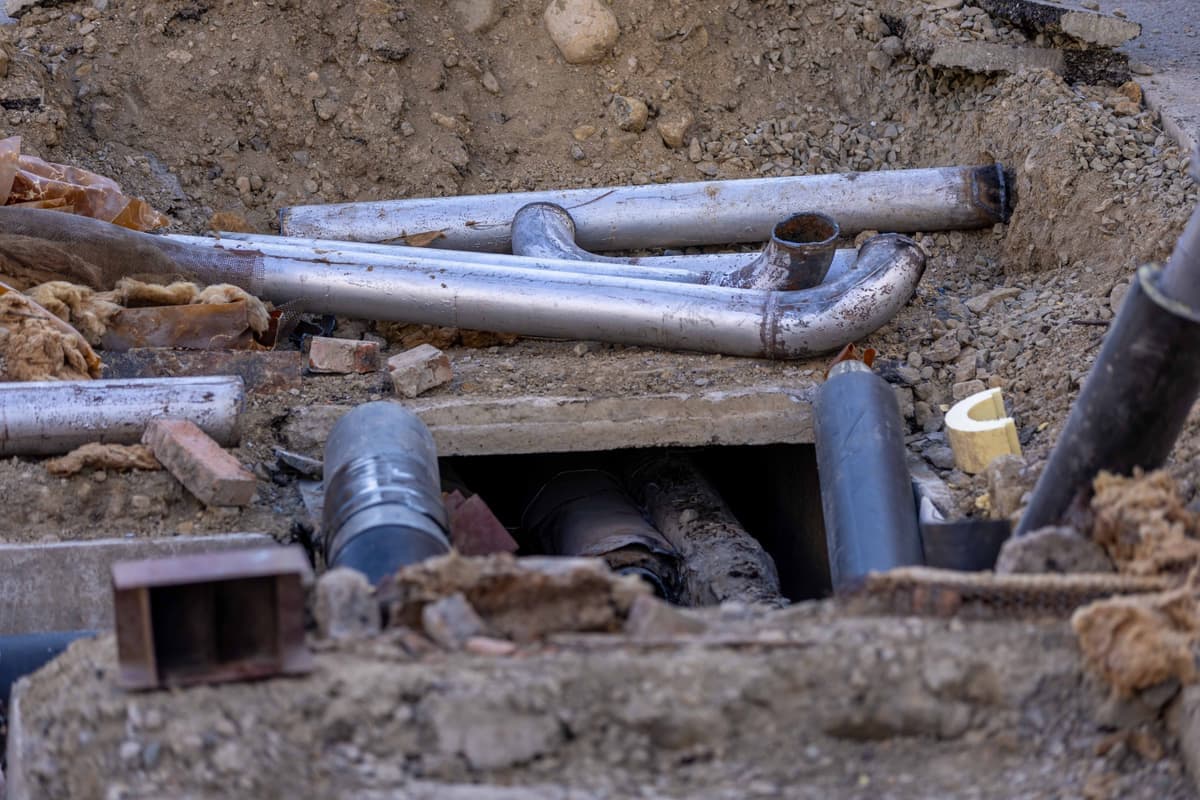
Roots get into a sewer line through a joint or crack that is already leaking, because the escaping water and nutrients draw them. The usual signs are slow drains throughout the house, gurgling toilets, repeated clogs in the same place, and sewage backing up at the lowest drain. Cutting the roots restores flow; it does not close the opening they came through, so they grow back unless the pipe is repaired or replaced.
The Signs You Actually Have Roots, Not Just a Clog
A single slow sink is a local clog. Roots in the main line produce a pattern, and the pattern is what distinguishes them. Everything downstream of the intrusion is affected, which means the whole house behaves badly at once and the lowest fixtures behave worst.
The other signature is recurrence. A grease or paper clog cleared properly stays cleared. A root mass cut out of a pipe grows back on the same schedule it grew the first time, so people with root intrusion often describe needing the line cleared every year or two, like a subscription.
- Multiple drains slow at the same time, especially tubs, showers and floor drains, which sit lowest in the system.
- Toilets gurgle or bubble when a washing machine drains or another fixture is used, which is air being pushed back past an obstruction.
- A clog that returns on a predictable cycle - every spring, every year, every eighteen months - rather than once.
- Sewage backing up at the lowest drain in the house: a basement or garage floor drain, a downstairs shower, or the lowest toilet.
- A patch of lawn over the sewer line route that is greener, faster growing or soggier than the rest of the yard.
- A sewer or sulfur smell outdoors near the line route, or indoors if a trap has been emptied by the pressure swings.
- A plumber's auger that comes back with white stringy fibers or fine root hairs on the cutter head - the single most direct confirmation short of a camera.
Why Roots Get In (and Why Dallas Yards Feed Them)
Roots do not drill through sound pipe. They grow toward moisture and nutrients, and a sewer line that is leaking even slightly at a joint puts out both. A hairline root finds the gap, gets into the warm, nutrient-rich flow inside, and then thickens inside the pipe where there is nothing to stop it. Within a season or two a hair becomes a mat that catches paper and grease, and the mat is what blocks the line.
That sequence matters for what you do about it, because it means the root is a symptom. The defect in the pipe came first.
Older Dallas-area neighborhoods combine the three conditions that make this common. The first is pipe material: homes built before the 1970s commonly ran vitrified clay tile or cast iron laterals. Clay comes in short sections with mortared or gasketed joints at regular intervals, and every joint is a potential entry point. Cast iron corrodes from the inside and eventually cracks.
The second is the trees. The mature canopy that makes neighborhoods in East Dallas, Oak Cliff, Richardson, Garland and the older parts of Plano and Irving so pleasant is the same canopy whose root systems extend well past the drip line in search of water.
The third is the soil. Expansive North Texas clay swells and shrinks through wet and dry cycles, and that movement works on rigid clay and cast iron joints year after year. A drought summer followed by heavy autumn rain is exactly the cycle that opens a joint - and a drought summer is also when tree roots range furthest looking for water. The two problems arrive together.
Safe First Steps Right Now
If drains are slow but nothing is backing up, you have time and there are a few things worth doing. If sewage is coming up inside the house, skip to the next section: that is a stop-and-call situation, not a DIY one.
- Stop adding water. Hold off on laundry, dishwasher and long showers until you know the line is clear. Every gallon you send down has nowhere to go.
- Check whether it is the whole house or one fixture. Run water at the furthest and lowest fixtures and watch. Whole-house slowness points to the main line; one slow drain usually does not.
- Find your cleanout. It is usually a capped pipe at ground level outside, near the house or along the line route toward the street. Knowing where it is saves a plumber time, and a cleanout under pressure is also an early warning.
- Do not pour chemical drain cleaner down a main line you think has roots. It will not clear a root mass, it sits in the pipe, and it makes the line hazardous for the plumber who has to open it.
- Skip the copper sulfate and foaming root killer until the line has been inspected. These products are sold for root control, their use is regulated in some places, and using one before anyone has seen the pipe just delays the diagnosis that actually matters.
- If you can safely do so and the backup is active, shut off water to the house to stop the flow while you wait. Our guide on shutting off the water to your house covers where the valves are.
- Photograph any backup and any damage before cleaning up, for your records and any insurance claim.
When to Stop and Call a Licensed Plumber
Sewage is a health hazard, and a main line is not a DIY repair. These are the points at which you should stop working on it yourself.
- Sewage backing up into the house at any fixture or floor drain. Keep people and pets away from it and get a plumber out.
- Multiple drains backing up at once, which means the obstruction is in the main line rather than a branch.
- Water or sewage surfacing in the yard along the line route, which can mean the pipe has failed rather than just blocked.
- A clog you have already had cleared once that has come back. That is the signal for a camera inspection rather than another cleaning.
- Any renting of a powered auger for a main line. A machine that can cut roots can also break old clay, hook and tear cast iron, or injure the operator.
- An older home where nobody knows what the lateral is made of. Knowing that before anyone pushes a cutter down it is worth the inspection fee.
Cutting the Roots vs Fixing the Pipe
This is the decision that matters, and the one most people are not given clearly. Cutting and repairing are not two prices for the same outcome.
Mechanical cutting, with a cable machine and a root-cutting head, pushes through the mass and clears a channel. Flow comes back the same day, which is usually what you called about. What it does not do is close the crack or joint the roots entered through, and it leaves the root system outside the pipe entirely intact. The roots regrow into the same opening, so you are buying time measured in months to a couple of years.
Hydro jetting goes further: a high-pressure hose scours the pipe wall as well as clearing the blockage, which removes the fine root hairs and the grease and scale they caught. It leaves a cleaner pipe, and on a line that is sound apart from one intrusion point it is the better clean. It still does not repair the defect, and on fragile old clay a jetter needs a plumber who has looked at the pipe first.
Repair closes the opening. Depending on what the camera finds, that might be a spot repair at one joint, a trenchless liner that creates a new jointless pipe inside the old one, pipe bursting, or a conventional dig-and-replace of a section or the whole lateral. These cost materially more than a cleaning, and they are the only options that stop the cycle.
The sensible sequence is almost always: clear the line so you have drains, camera the line to find out why it blocked, then decide on a repair with that information in hand. Agreeing to a repair before the camera, or declining the camera after a second clog, are the two ways this goes wrong.
- Cable cutting: fastest and cheapest, restores flow, roots return. A reasonable first move in an active backup.
- Hydro jetting: cleans the pipe wall as well as the blockage, better result on a scaled or greasy line, still not a repair. Our hydro jetting cost guide covers the published figures.
- Camera inspection: not a fix, but the step that tells you which fix you need and where. Essential after a second clog.
- Spot repair: dig to one failed joint and replace it. Appropriate when the camera shows a single defect in otherwise sound pipe.
- Trenchless lining or pipe bursting: creates a jointless pipe, so there are no joints for roots to enter, with less yard disruption than a full dig.
- Dig and replace: the conventional answer when the lateral is clay or badly deteriorated cast iron along its length.
- Root control products: at best a maintenance measure between inspections, never a substitute for closing the hole.
Published Cost Figures for Root Work (With Sources)
We are a free referral service and we do not set prices. The figures below are what independent publishers report, named and dated, so you can see where a quote sits relative to published data. Cleaning figures and replacement figures are different orders of magnitude, which is the whole point of knowing which one you are being quoted.
| Service | Published figure |
|---|---|
| Tree root removalFixr.com, Cost to Unclog Main Sewer Line, updated January 31, 2025; its labor-included table gives $100 to $800. This Old House, updated March 30, 2026, gives $80 to $1,000 | $100 - $600 |
| Root cutting with a cable machine - averageFixr.com, updated January 31, 2025 | $200 - $450 |
| Snaking / augerFixr.com, updated January 31, 2025 | $100 - $500 |
| RoddingFixr.com, updated January 31, 2025 | $150 - $600 |
| Hydro jettingFixr.com, updated January 31, 2025 | $350 - $600 |
| Camera / video inspectionFixr.com, updated January 31, 2025; up to $1,500 for an entire home sewer system. This Old House, updated March 30, 2026, gives $100 to $500 | $100 - $800 |
| Installing a sewer cleanoutFixr.com, updated January 31, 2025; relevant where an older home has no accessible cleanout | $600 - $2,000 |
| Sewer line replacement - overallThis Old House, Sewer Line Replacement Cost, updated March 30, 2026; average given as $3,320 | $1,390 - $5,320 |
| Sewer line replacement - per linear footThis Old House, updated March 30, 2026; traditional excavation $50 to $200 per foot, trenchless $60 to $250 per foot | $50 - $250 / foot |
| Permits for sewer workThis Old House, updated March 30, 2026; varies by city, and in Texas permitting is handled locally | $100 - $1,000 |
| After-hours emergency chargeFixr.com, updated January 31, 2025; the page also notes evening, weekend and holiday premiums of $45 to $200 added to the hourly rate | $50 - $100 |
These are published figures from Fixr.com (updated January 31, 2025) and This Old House (updated March 30, 2026, cost data from Angi unless otherwise noted). They are national, not Dallas-Fort Worth specific, not Dallas Best Plumber's prices and not a quote. Cleaning a line and repairing a line are different jobs at very different costs - compare a quote against the row that matches the work being proposed. We are a free referral service: we do not set prices and we do not perform work.
Sources: Fixr.com - Cost to Unclog Main Sewer Line (updated January 31, 2025); This Old House - Sewer Line Replacement Cost (updated March 30, 2026)
Keeping Roots Out Once the Pipe Is Fixed
A repaired or lined pipe with no open joints is the only reliable root defense, because roots need an opening. Everything else is maintenance that buys time. Still, a few habits reduce the chance of the next intrusion and catch one early if it happens.
- Know where your lateral runs, and avoid planting large trees or fast-growing species along that route.
- Have the line camera-inspected before buying an older home, and again if you have had one main line clog, not after the third.
- Treat a yearly or biennial clog as a diagnosis, not a chore. Repeat cleanings cost more over five years than closing the defect once.
- Keep grease and wipes out of the drains. They do not cause root intrusion but they turn a small root mat into a full blockage much faster.
- Make sure you have an accessible cleanout. It lowers the cost of every future service call and it gives you a pressure-relief point in a backup.
- After a drought summer, watch for the first signs in autumn, because that is when soil movement and root searching both peak in North Texas.
Get Matched With a Licensed Dallas-Area Plumber
Dallas Best Plumber is a free referral service, not a plumbing company. Tell us what the drains are doing, whether this has happened before, and roughly when the house was built, and we match you with a licensed, insured plumber serving your ZIP who can clear the line, camera it and quote the repair honestly. The match is free and there is no obligation.
If sewage is backing up inside the house right now, treat it as an emergency: stop using water, keep people away from the affected area, and request the match straight away. Our main sewer line clog guide covers the immediate sequence, and our sewer line replacement cost guide covers the published figures if the camera finds a failed lateral.
Still stuck? Get matched with a licensed local pro
We'll connect you with a licensed, insured plumber in the Dallas-Fort Worth area for a free, no-obligation quote.
Related guides
- Main Sewer Line ClogOne slow drain is a fixture problem. Several at once, with gurgling, is the main line - and the first thing to do is stop running water.
- Sewer Line Replacement CostThis is the plumbing job with the widest spread of any - and almost all of it comes down to length, depth, and what is on top of the pipe.
- Sewer Camera Inspection CostThe cheapest money you can spend on a sewer line, because it is the only thing that tells you whether the next quote should be a cleaning or a replacement.
- Hydro Jetting CostIt costs more than snaking because it does more - and on the wrong pipe it is the more expensive mistake. Here is how to tell which you have.
- Sewer Smell In The HouseSewer gas gets in through one of a short list of openings. Work through them in order and you will usually find it in an afternoon.
Frequently asked questions
How do I know if tree roots are in my sewer line?
Look for the pattern rather than a single symptom: several drains slow at once, toilets gurgle when other fixtures drain, sewage appears at the lowest drain, and the same clog returns every year or two. A greener or soggier strip of lawn along the line route is another sign. A camera inspection is the only way to confirm it and see how bad it is.
Will cutting the roots fix the problem permanently?
No. Cutting clears the blockage and restores flow, but it leaves the crack or joint the roots entered through and the root system outside the pipe. They grow back, usually within months to a couple of years. Only repairing, lining or replacing the pipe closes the opening and ends the cycle.
How much does it cost to remove tree roots from a sewer line?
Fixr.com publishes tree root removal at $100 to $600, with $100 to $800 in its labor-included table and root cutting averaging $200 to $450. This Old House gives $80 to $1,000. Those are cleaning figures. A sewer line replacement is a different order of magnitude: This Old House publishes $1,390 to $5,320 with a $3,320 average.
Do chemical root killers work in a sewer line?
They can slow regrowth as a maintenance measure, but they do not clear an existing blockage and they do not repair the defect the roots came through. Their use is also regulated in some places. Do not pour anything down a main line you believe has roots before a plumber has inspected it, because it makes the line hazardous to open and delays the real diagnosis.
Why are tree roots in sewer lines so common in older Dallas neighborhoods?
Three things line up. Homes built before the 1970s often have clay tile or cast iron laterals, and clay has a joint every few feet. The mature tree canopy in older neighborhoods sends roots well past the drip line looking for water. And expansive North Texas clay soil swells and shrinks through wet and dry cycles, working those joints open year after year.
Does homeowners insurance cover tree roots in a sewer line?
Root intrusion is usually treated as gradual damage rather than a sudden accident, which standard policies commonly exclude, and the sewer lateral on your property is generally your responsibility rather than the city's. Some carriers sell a separate service line endorsement that can apply. Check your own policy and endorsements, and see our guide on whether homeowners insurance covers plumbing.